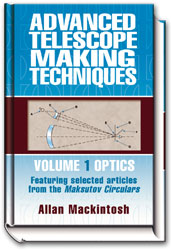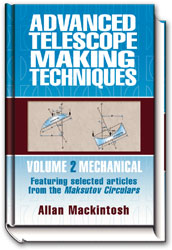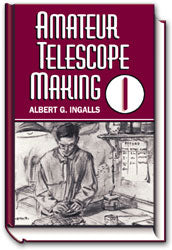
Amateur Telescope Making 1: Newtonian Telescope
Mirror Making; Optical Testing; Workshop Wisdom; and Observatory
Buildings. 6.00" by 9.00", 590 pages, hardbound, 2Lbs.
ship wt. $24.95
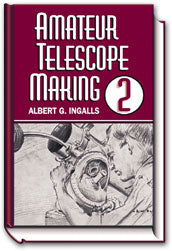
Amateur Telescope Making 2: Refractor Telescopes;
Telescope Mechanics; Telescope Adjustments; Binoculars; Schmidt
Cameras; and Optical Flats. 6.00" by 9.00", 590 pages,
hardbound, 2Lbs. ship wt. $24.95
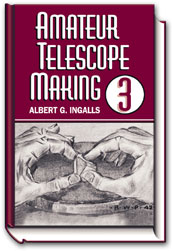
Amateur Telescope Making 3: Optical Production
Methods and Machinery; Eyepieces and Small Lenses; Optical Coatings
and Coating Equipment; The Eye and Atmosphere; Other Optical Instruments;
and Instrumentation for Solar Observations. 6.00" by 9.00",
630 pages, hardbound, 2Lbs. ship wt. $24.95
|
In the early
1920s a naturally curious fellow, Albert Ingalls, happened to read an article
in an obscure magazine by an even more curious fellow, Russell Porter. The
article was about the "Poor Man's" telescope and told the story of how a group
of Vermont villagers built their own reflecting telescopes. It was to be a
fateful event because Albert Ingalls was an editor of Scientific
American magazine and telescope making was about to gain a much larger
audience through America's preeminent science magazine. Ingalls and Porter
would, during the next 30 years, create and inspire from others a body of
literature that would eventually span a three-volume set of books.
Many people are surprised when
they find out that the optics for a 6 or 8 inch Newtonian reflecting telescope
can be made by hand using the simplest of tools and materials. Since the
invention of the telescope about 400 years ago, telescope making has always had
an amateur component. Some amateur telescope makers were fascinated by the
process itself, while others (like the great observer of the night sky, William
Herschel) became amateur telescope makers as a means to their ultimate
objective of exploration.
Inevitably some of the more
accomplished amateurs became professionals and made instruments for others, but
these instruments were never cheap. Until the discovery of methods to coat
glass with silver in the mid-1800s the telescope of choice was the
refractorin spite of its price. By the time aluminum replaced silver in
the late 1930s, reflectors had almost completely replaced refractors in
popularity. This series of books is one of the reasons why.
The ATM books were originally
published at a time when it was costly to rearrange the contents once it was
set in type, so with each edition and printing new material tended to be added
at the back. Over the years they grew larger and less well organized. Yet,
because they contained so much valuable information, telescope makers, even
today, considered them to be the bible of telescope making.
These books are a rearrangement of
the original three-volume work. Insofar as possible similar items
are now grouped together; each as a Chapter within a descriptive
Part. Chapters are usually divided into sections, subsections, etc.
While the Table of Contents for a typical "ATM" of old was 2 pages
it is now 3 to 5 times larger. The Index has similarly been expanded.
The objective was not to rewrite but to logically rearrange the
text into a more user-accessible format. Spelling, hyphenation and
usage have been standardized, and errors-in-fact corrected, but
almost all the original text remains fundamentally unchanged (pendulum
clocks and vacuum tube photoelectric photometry articles were cut)
and now makes up nearly 1,800 pages of text and illustrations devoted
to practical telescope making.
Tables of
Contents
Amateur Telecope Making Book
1 A Newtonian Telescope Mirror
Making 1 A.1 Mirror Making for Reflecting
Telescopes 3 A.1.1 Introduction to
the Reflecting Telescope 3 A.1.2 Grinding
the Mirror 5 A.1.3 Making the Pitch Lap
6 A.1.4 Polishing the Mirror 7
A.1.5 Testing the Mirror 8
A.1.6 Figuring the Mirror 11
A.1.7 Silvering the Mirror 17
A.1.8 Biographical Note by the Editor 21
A.1.9 Note Added in 1996 21
A.2 The Beginner's First Telescope 25
A.2.1 Editor's Note 25
A.2.2 Introduction 26
A.2.3 The Poor Man's Telescope 28
A.2.4 The Main Thing is the Mirror 30
A.2.5 And So 33
A.2.6 Now We Start 35
A.2.7 Keep Hogging 36
A.2.8 Checking Progress 38
A.2.9 No More Long Strokes 40
A.2.10 Scratches 42
A.2.11 Polishing 43
A.2.12 All Set to Begin Polishing 44
A.2.13 Mounting the Poor Man's Telescope 48
A.2.14 Collimation 53
A.2.15 Albert G. Ingalls Editor's Note 56
A.2.16 Notes Added in 1996 62
A.3 The HCF Lap 63 A.3.1
Advantages of HCF 63 A.3.2 Making and Using
an HCF Lap 64 A.3.3 Using HCF for Zonal
Correction 66 A.4 The Amateur's Telescope
69 A.4.1 Introductory 69
A.4.2 Literature 71
A.4.3 Tools and Materials 72
A.4.4 Rough Grinding 74
A.4.5 Testing; Foucault's Shadow Test 79
A.4.6 Polishing 83 A.4.7 Figuring 87
A.4.7.1 Parabolizing by Long
Stroke 88 A.4.7.2
Parabolizing by Graduating Facets 89
A.4.7.3 Parabolizing by the
Small Polisher System 90
A.4.7.4 Parabolizing by Overhang 90
A.4.7.5 Working Uphill 91
A.4.8 Editor's Note 94
A.4.9 How to Recognize the Paraboloid, Zonal
Testing 95 A.4.10 Silvering 101
A.4.10.1 To Polish the Film
101 A.4.10.2 A Few Hints
on Silvering 102 A.4.10.3
Care of the Film 103
A.4.11 Mounting the Mirror 104
A.4.12 A Last Word to
Beginners on Insufficient Grinding 107 A.5 An
Amateur's View of Mirror Making 111
A.5.1 From One TN to Another 111
A.5.1.1
Pitch 111
A.5.1.2
Abrasive Action, Rolling and Stationary 111
A.5.1.3 The
Spit Test for Radius of Curvature 112
A.5.1.4 Tool
Effect 113
A.5.1.5
Thermal Effect 113
A.5.1.6
Evaporation Effect 114
A.5.1.7
Friction Effect 116
A.5.1.8 Tool
Deformation 117
A.5.1.9 Tool
Plowing 118
A.5.1.10 The
Clock Stroke 118
A.5.1.11 The
Blending Overhand Stroke 119
A.5.1.12 The
Semistroke 120
A.5.2 Backwoods Technique 120
A.5.2.1 The
Handle 120
A.5.2.2 The
Grip 120
A.5.2.3 Rough Grinding 121
A.5.2.4 Fine
Grinding 123
A.5.2.5 The
Lap 124
A.5.2.6 Polishing 127
A.5.2.7
Correcting 128
A.5.2.8
Figuring 134 A.5.3 The Second Mirror 135
A.5.4 In Retrospect 136
A.6 Subdiameter Tools 139
A.6.1 Large Mirrors and Subdiameter Tools 139
A.6.2 Use of Subdiameter Tools on a 12-inch
Mirror 140 A.6.3 Use of Subdiameter Tools on
a 10-inch Mirror 141 A.6.4 Construction of
Subdiameter Tools 144 A.7 The Prism or Diagonal
147 A.7.1 Editor's Notes 151
A.7.2 Sizing a Newtonian Diagonal 151
A.7.2.1 Addendum, 1948 154
A.8 Prism Diagonals-Axial Aberration Effects
157 A.8.1 Axial Spherical
Aberration 158 A.8.2 Axial Chromatic
Aberration 159 A.8.3 Effect on Definition
160 A.8.4 Extra-Axial Aberrations 161
A.8.5 Prism Glasses 162
A.9 How to Make a Diagonal for a Newtonian 163
A.9.1 Making the Blank 163
A.9.2 Making a ``Surround'' 164
A.9.3 Grinding 165
A.9.4 Polishing 166
A.9.5 Testing for Flatness 166
A.9.6 Mounting the Diagonal 167
A.10 The Building of a 19-Inch Reflecting Telescope 169
A.10.1 The Mirror 170
A.10.2
Mounting 178 A.10.3 The Clock 184
A.10.4 Note Added in 1996
186 B Optical Testing 187 B.1
Curves Found During Figuring 189 B.2 Where Is The
Crest Of The Doughnut? 197 B.2.1 A
Study in Shadows 197 B.3 Accuracy in Parabolizing a
Mirror 201 B.3.1 Editor's Note
206 B.3.2 Note Added in 1996 207
B.4 The Ronchi Test for Mirrors 209
B.4.1 Note Added in 1996 214
B.5 Hindle's Method in the Knife-edge Test 215
B.6 The Slit Test 219
B.7 Shadow Appearance 223
B.7.1 Doughnut Mathematics 225 B.7.2 Shadow
Behavior 231 B.7.3 The Error of Observation
235 B.7.4 Accuracy of the Knife-edge Test
238 B.7.5 Testing Equipment 240
B.7.6 Testing Routine 243
B.7.7 Note Added in 1996 248
B.8 The Caustic Test 251
B.8.1 Caustic Testing Procedure 262 B.8.2
Interpretation 265 B.8.3 Sample Calculations
266 B.8.4 Test Rigs 268
B.8.4.1 Test Rig for Second
Method 269 B.8.4.2 Test
Rig for Third Method 269 B.8.5 Accuracy
276 B.8.6 Nonparaboloidal Surfaces 280
B.8.7 Editor's Note 281
B.8.8 Note Added in 1996 283
B.9 Quantitative Optical Test for Telescope Mirrors 285
B.9.1 Quantitative Failure of Test 285
B.9.2 Apparatus and Procedure 286
B.9.3 Geometry of Test 288
B.9.4 Appearances of Common Forms of Aberration
289 B.9.5 Editor's Note 289
B.9.6 Notes on the Ronchi Band Patterns 290
B.9.7 Note Added in 1996 292
B.10 Gregorian Secondary Test 293
B.10.1 Editor's Note, 1948 297
B.11 The Hartmann Test 299 B.12 Notes
on the Optical Testing of Aspheric Surfaces 305
B.12.1 The Ellipsoid 305
B.12.2 Testing The Paraboloid On Near Objects
308 B.12.3 Quantitative Test of
Hyperboloidal Mirrors 310 B.12.4 Note Added
in 1996 314 B.13 Null Test for Paraboloids 315
B.13.1 Editor's Note 319 B.14
Testing Convex Spherical Surfaces 321 B.15 A
Bilateral Slit Mechanism 325 B.16 Small
Pinholes 329 B.16.1 Determining the
Optimum Size 329 B.16.2 Illuminating the
Pinhole 331 B.16.3 Making the Pinhole
332 B.16.4 Differences in Usage Between
Small and Large Pinholes 332 B.16.5 Note
Added in 1996 334 B.17 Astigmatism 335
B.18 Optical Bench Testing 341
B.18.1 Introduction 341
B.18.2 Lens Characteristics 341
B.18.3 A Nodal Slide Optical Bench 343
B.18.3.1 Illuminator 344
B.18.3.2 Telescope-microscope
345 B.18.3.3 The Optical
Bench Proper 347 B.18.3.4
The Slides X and S 347 B.18.4
Alignment 347 B.18.5 Testing Methods 349
B.18.5.1 Tests on the Axial
Image 350
B.18.5.1.1
Equivalent Focal Length 350
B.18.5.1.2
Back Focal Length 351
B.18.5.1.3
Working Distance 351
B.18.5.1.4
Flange Focal Length 352
B.18.5.1.5
Axial Critical Aperture Ratio or Aperture Tolerance 352
B.18.5.1.6
Axial Chromatic Aberrations 353
B.18.5.2 Axial Spherical and Zonal Aberrations 353
B.18.5.3 Tests Using Extra-Axial
Images 354
B.18.5.3.1 Curvature of Image Field 354
B.18.5.3.2
Lateral Chromatic Aberration 357
B.18.5.3.3
Distortion 357 B.18.5.4
Comatic, Lateral Spherical or Sinical Aberration 358
B.18.5.5 Astigmatism 358
B.18.5.6 Testing Complete
Telescopes 359
B.18.5.6.1
Convergent Tubes 362
B.18.5.6.2
General Caution 363 B.18.5.7 Approximate
Refractometry 363
B.18.5.7.1 Radius Measurement in General 365
B.18.6 Summary 366 B.18.7 References 367
B.19 Interference of Light 369
B.19.1 Newton's Fringes 374
B.19.2 Haidinger's Fringes 378
B.19.3 Low-reflection Coatings 380
B.19.4 Diffraction 383
B.19.5 Image Spikes 383
B.19.6 Focal Diffraction 387
B.19.6.1 Edge Diffraction
387 B.19.7 Refractor vs. Reflector 392
B.19.8 References 392 B.19.9 Notes Added in 1996
393 C Workshop Wisdom 395 C.1
Advice From TN's 397 C.1.1 General
397 C.1.1.1 Choosing a
Mirror Size 397 C.1.1.2
Walking Around the Barrel 397
C.1.1.3 The Correct Level for
Grinding and Polishing 398
C.1.1.4 Flexure 398
C.1.1.5 Warping of Wood on which Tool is Mounted 398
C.1.1.6 Uniform Working
Temperature 399 C.1.1.7
Keep a Log Book 399
C.1.1.8 Sagitta equals r2/2R 400
C.1.1.9 When r2/2R is not
exact enough 400 C.1.1.10
Scratches 402 C.1.1.11
Mirror Breakage 403
C.1.1.12 Workplace Cleanliness 403
C.1.1.13 Shipping a Mirror
404 C.1.1.14 Take Courage
404 C.1.1.15 Three in One
405 C.1.2 Mirror Substrates 405
C.1.2.1 Fused Quartz 405
C.1.2.2 Pyrex 406
C.1.2.3 How Plate Glass is
Made 407 C.1.2.4 Optical
Glass 407 C.1.2.5 Glass
Mirror Substitutes 408
C.1.2.6 Rotating Mercury Mirror 412
C.1.2.7 Cellular Mirror
413 C.1.2.8 Cemented,
Built-Up Disks 415 C.1.2.9
Suction Mirror 416
C.1.2.10 Magnesium Oxychloride Mirror 416 C.1.3
Cutting Circular Disks and Holes 417 C.1.4 Tools
and Fixtures 418 C.1.4.1
Inverting Tool and Mirror 418
C.1.4.2 Inverting Device
419 C.1.4.3 Limiting
Devices 419 C.1.4.4 Making
Templates 420 C.1.4.5 Metal
Template 420 C.1.4.6 Removable
Handle for Mirror Disks 421
C.1.4.7 Grinding Stands 421 C.1.5 Grinding
Abrasives 421 C.1.5.1
Designations for Carbo Grain Sizes 421
C.1.5.2 Crushed Steel and
Pyrex 422 C.1.6 Grinding 422
C.1.6.1 Who Discovered the
Method of Concaving a Glass Disk? 423
C.1.6.2 Nature of Grinding 424
C.1.6.3 Wets 424 C.1.6.4
One-third Strokes 424 C.1.6.5
Strokes in Grinding 425 C.1.6.6
Why Disks Grind Concave 426
C.1.6.7 Refusal of the Mirror to Become Concave 426
C.1.6.8 Amount of Glass Removed for Each Stage
427 C.1.6.9 Chamfering Disks
428 C.1.6.10 Getting Overall
Contact while Grinding 428 C.1.6.11
Bad Central Contact in Final Grinding 429
C.1.6.12 Estimating Fineness of Grinding 430
C.1.6.13 Streak of Rouge Test for
Contact in Fine Grinding 431
C.1.6.14 Water Drop Test for Contact in Fine Grinding 431
C.1.6.15 Sticking Mirror 431
C.1.6.16 Mirror Sticks to Tool 432
C.1.6.17 Get a Sphere before Beginning
to Polish 433 C.1.6.18 When is Fine
Grinding Finished? 434 C.1.6.19
Finishing With Emery 434 C.1.6.20
Searching for Tiniest Pits 435
C.1.6.21 Futility of Attacking Big Pits with Rouge 435
C.1.6.22 Test for Center of Curvature During Grinding
437 C.1.6.23 Keeping Track of the
Radius of Curvature While Grinding 437
C.1.6.24 Very Exactly Finding the Radius of Curvature 438
C.1.6.25 Bubbles Between Mirror and Tool
438 C.1.7 Pitch Laps 438
C.1.7.1 Pitch 438
C.1.7.2 Making the Pitch Lap 439
C.1.7.3 Modifications of the Plain Pitch Lap. 444
C.1.7.4 Straining Pitch 445
C.1.7.5 Speckling of lap 445
C.1.7.6 Pitch Flammability 446
C.1.7.7 Channels in Laps 446
C.1.8 Nonpitch Laps 446
C.1.8.1 The HCF Lap 446 C.1.8.2 The
Paper Polishing Lap 449 C.1.8.3 Laps
in Hot Places 450 C.1.8.4
Substitutes for Pitch 450 C.1.9 Polishing Agents
450 C.1.9.1 Rouge Size 450
C.1.9.2 How to Make Rouge 450
C.1.9.2.1 Editor's Note
452 C.1.10 Another Method for Making Rouge
453 C.1.11 Breaking-up Rouge 453
C.1.12 Polishing 453
C.1.12.1 Polishing, Theory 453
C.1.12.2 Grabbing 459 C.1.12.3
Sleeks 460 C.1.12.4 Scratches From
Rouge 460 C.1.12.5 Stuck Disks
460 C.1.12.6 Test for Complete
Polish 461 C.1.12.7 Detecting the
Most Minute Pits and Scratches 461
C.1.12.8 Cold Pressing 461 C.1.12.9
Prolonged Cold Pressing 461 C.1.13 Figuring
462 C.1.13.1 Correcting Turned-up
Edge 462 C.1.13.2 Correcting a Hole
462 C.1.13.3 Correcting a Hyperbola
463 C.1.13.4 Forestalling
Turned-down Edge 463 C.1.13.5
Turned-down Edge 463 C.1.13.6 Turned
Edge 463 C.1.13.7 Test for Slight
Turned Edge 464 C.1.13.8 Diffraction
Effects 465 C.1.14 Testers 465
C.1.14.1 A Cool Pinhole 465
C.1.14.2 Permissible Distance Differential of
Pinhole
and Knife-edge along the Axis
466 C.1.14.3 Electric Lamp for
Knife-edge Test 466 C.1.14.4 Tiny
Pinhole for Advanced Workers 467
C.1.14.5 Slow Motion Devices for Testing 467
C.1.14.6 Reversing Knife-edge 467
C.1.14.7 Testing Tunnel 468 C.1.15
Testing 468 C.1.15.1 First
Announcement of Foucault Test 469 C.1.16 Conic
Sections 471 C.1.17 Record Keeping 473
C.1.18 Correct Paraboloidal Shadow 475
C.1.18.1 Measuring Zones 476
C.1.18.2 Testing without Masks 477
C.1.18.3 Interpreting Shadows 478
C.1.18.4 Precision in Reading Knife-edge
Shadows 479 C.1.18.5 The
Inside-and-outside Test 480
C.1.18.5.1 Editor's Note 481
C.1.18.6 Learning to Understand the Knife-Edge Test
482 C.1.18.7 Avoiding
Fatigue in the Knife-edge Test 483
C.1.18.8 Making Focograms 484
C.1.18.9 Diffraction Ring (Star) Test 486
C.1.19 Abnormalities 493
C.1.19.1 Warped Mirror 493
C.1.19.2 Astigmatized Mirror 494
C.1.19.3 Striae 494
C.1.19.4 Strains in Glass and Their Detection 494
C.1.19.5 Editor's Note 497
C.1.20 Notes on the Eyepiece 498
C.1.21 Telescope Mechanics 502
C.1.21.1 Tubeless Telescope 502
C.1.21.2 Hardening Brass 502
C.1.21.3 Blackening Brass 502
C.1.21.4 Paint for Inside of Tube 502
C.1.21.5 An Adapter Tube 502
C.1.21.6 Finders 503
C.1.21.7 More about Finders 504
C.1.22 Telescope Designs 505
C.1.22.1 Ritchey-Chrétien 505 C.1.22.2
Cassegrainian Notes 507 C.1.22.3 The Herschelian
Telescope 514 C.1.23 Literature of Interest to the TN 515
C.1.23.1 Observatories 515
C.1.23.2 Herschel's Mirrors 516
C.1.23.3 Properties of Pitch 517 C.1.23.4 Wassell
and Blacklock Letters 517 C.1.24 Graduating Setting Circles
517 D Observatory Buildings 5199
D.1 Telescope Housings 521 D.1.1
The Warmed Observing Room 521 D.1.2 Turret
Telescopes 523 D.2 The Amateur's Observatory
527 D.2.1 Observatory Size 530
D.2.2 Weatherproofing 531
D.2.3 Rollers 531 D.2.4 The Sliding
Roof Observatory 532 D.2.5 Domes 534
D.2.5.1 Shutters 543
D.2.5.2 Revolving the Dome 544
D.3 Thermal Effects of Observatory Paints 549
D.3.1 Introduction 549 D.3.2 Test
Procedures 549 D.3.3 Interior painting 552
Amateur Telecope Making Book
2 A Refractor Telescopes
1 A.1 Reflectors versus Refractors
3 A.1.1 Introduction 3
A.1.2 An Inexpensive Mounting and Shelter 4
A.1.2.1 The Question of Air Currents in the Tube
7 A.1.2.2 The Diffraction Rings
11 A.2 The Achromatic Object Glass 15
A.2.1 Calculating Curves. First step 16
A.2.2 Practical---Shaping and Grinding 25
A.2.3 Polishing 29
A.2.4 Testing and Figuring 30 A.2.5 Mounting the
Lens 36 A.2.6 Editor's Notes 40
A.2.6.1 Measuring Edge Thickness 40
A.2.6.2 Conventions Used in Designing Objective
Lenses 40 A.2.7 Biographical Note 41
A.3 The RefractorDesign and Construction
43 A.3.1 Editor's Note 43
A.3.2 Introduction and Theoretical Considerations
44 A.3.3 Making an Achromatic Object Glass 74
A.3.3.1 Making a Flat for Testing
74 A.3.3.2 Spherometers 77
A.3.3.3 And So To Work 79
A.3.3.4 Metal Laps 80
A.3.3.5 Grinding the Curves 85
A.3.3.6 Edge Thickness 87
A.3.3.7 Ronchi-Testing the Lens 88
A.3.3.8 Centering 90
A.3.3.9 The Cell 92
A.3.3.10 Cementing 93
A.3.4 Note Added in 1996 98 A.4 The
RefractorMetal Parts and Mounting 101
A.4.1 Size 102
A.4.2 Material 103
A.4.3 Costs 105
A.4.4 Practical 105
A.4.5 Machining the Main Tube 106
A.4.6 The Cell 108
A.4.6.1 The Outer Cell 110
A.4.7 Cell Assembly Made from Heavy-wall Tubing
112 A.4.8 The Control End 114
A.4.9 The Focus Control 114
A.4.10 Finish 118
A.4.11 Assembling the Parts 118
A.4.12 Diaphragms 119 A.4.13 The
Mounting 120 A.4.14 The Tripod 121
A.5 Design of Refractors by the G-sum Method 125
A.5.1 Introduction 125
A.5.2 Sign Convention 126 A.5.3 Design of a
Cemented Doublet 127 A.5.4 Design of a Fraunhofer
Type Objective 130 A.5.4.1
Airspacing 132 A.5.5 Barlow Lens 134
A.5.6 Thickness 134
A.5.7 Conclusions 135
A.5.8 Note Added in 1996 138
A.6 Design of Refractors by Ray Tracing 139
A.6.1 The Ray Trace Method 139 A.6.2
The Equations of Ray Tracing 141
A.6.2.1 Lens Aberrations 145 A.6.2.2
Spherical Aberration 146 A.6.2.3
Coma and OSC 146 A.6.2.4 Chromatic
Aberration 148 A.6.2.5 The
Path-Difference Method 151 A.6.3 Ray Trace Design
Procedure 155 A.6.4 In Conclusion 172
A.7 Computing the Radii of an Achromatic Objective
177 A.7.1 Editor's Note 177
A.7.2 Introduction 177 A.8
Optical Glass Procurement 189 B Telescope Mechanics
197 B.1 Telescope Mounts 199
B.1.1 Making the Mounting 199
B.2 Telescope Mounting Design Fundamentals; Rigidity 215
B.2.1 The Tube 225
B.2.2 The Mirror Cell 226 B.2.3 Machining 230
B.2.4 Résumé 232
B.2.5 Note Added in 1996 232 B.3 A Motor
Drive for the Telescope 233 B.4 Telescope
Drives 237 B.4.1 Drives for Larger
Telescopes 254 B.4.2 Drive for a 12.5" Fork Type
Reflector 255 B.4.3 Drive for a 14 reflector
257 B.4.4 Note Added in 1996 261
B.5 Hand-wound Spring Drives for Telescopes 263
B.5.1 Ordinary Clockwork Gramophone Motor 263
B.5.2 Combination Spring Motor and Weight-driven
Assemby 265 B.5.3 Spring-driven Phonograph Motor
Drive 266 B.5.4 "Hempstead Hydrant'' Mount
268 B.6 The Springfield Mounting 271
B.6.1 General Description 272
B.6.2 Pattern Making for the Springfield Mounting 277
B.6.2.1 Making the Actual Pattern
285 B.6.3 Casting 286
B.6.4 Molding and Casting Springfield Mounting Parts 287
B.6.4.1 Editor's Note 287
B.6.4.2 Introduction 287
B.6.4.3 The Furnace 288
B.6.4.4 The Crucible, and Tools to
Handle it 289 B.6.4.5 Cope and
Drag 290 B.6.4.6 Other
Equipment 291 B.6.4.7 Molding
Sand 292 B.6.4.8 Molding
293 B.6.4.9 Pouring the Metal
297 B.6.4.10 Brasses, Bronzes
and Miscellaneous 298 B.6.5 Machining the
Springfield Mounting 300 B.6.5.1
Miscellaneous 303 B.6.6 Motor Drives,
Counterweighting, Pier 306 B.6.6.1
Counterweighting 309 B.6.6.2 The
Pier 309 B.7 Molding and Casting a Fork
313 B.7.1 Editor's Note 313
B.7.2 The Mold 313
B.7.3 Casting 316 B.8 Mechanical Flotation of Mirrors
319 B.8.1 3-point Support 321
B.8.2 18-point Support 322
B.8.3 9-point Support 324 B.8.4 Note
Added in 1996 326 B.9 Cork Insulation for Reflecting
Telescopes 329 B.10 Making Setting
Circlesa Composite Chapter 333
B.10.1 Editor's Note 333 B.10.2 Editor's Note on
Dividing Heads 341 B.10.3 Correction of Periodic
Inequalities 346 B.10.4 Editor's Note 349
B.11 Wooden Tubes for Reflectorsa Composite Chapter
351 B. 12 Dealing with Spider Diffraction 357
B.12.1 Note Added in 1996 360 C Telescope
Adjustments 361 C.1 Collimation and
Adjustment 363 C.1.1 Collimation 363
C.1.2 Adjusting the Polar Axis 366
C.1.3 Indoor Adjustment of an Equatorial 367
C.1.3.1 Theory 370
C.1.4 Adjusting Telescope by Equatorial Star 375 D Binoculars
377 D.1 The Overhaul and Adjustment of
Binoculars 379 D.1.1 Types of Binoculars
380 D.1.2 Modern Binoculars 383
D.1.2.1 Body 383
D.1.2.2 Hinge 384
D.1.2.3 Objective Assembly 385
D.1.2.4 Lubricants 386 D.1.2.5 Waxes
387 D.1.2.6 Ocular Assembly 388
D.1.2.7 Prism Assembly 389
D.1.2.8 Covering and Finishes 392
D.1.2.9 Tolerances 393
D.1.2.9.1 Body Castings and Hinges
393 D.1.2.9.2 Objective
Fittings 394 D.1.2.9.3
Ocular Parts 394
D.1.2.9.4 Prism Plates 394
D.1.2.10 Optical System 394
D.1.2.10.1 Objective, Crown Lens 395
D.1.2.10.2 Objective, Flint Lens 397
D.1.2.10.3 Prisms 397
D.1.2.10.4 Ocular Field Lens 397
D.1.2.10.5 Crown Eyelens
397 D.1.2.10.6 Flint
Eyelens 397 D.1.2.11 Checking
and Matching Prisms 399
D.1.2.12 Centering and Cementing Lenses 403
D.1.2.13 Collimation 406
D.1.3 Semimodern Binoculars 412
D.1.4 Binoculars with Central Focusing Devices
414 D.1.5 Galilean Type Binoculars (Field
Glasses) 416 D.1.6 Evaluating a Binocular 417
E Schmidt Cameras 421 E.1 The Schmidt
Camera---Introductory 423 E.1.1 Editor's
Note 429 E.2 Theory and Design of Aplanatic Reflectors
433 E.3 Notes on the Construction of an F/1
Schmidt Camera 443 E.4 Schmidt Camera Notes
451 E.4.1 Focal Length 451
E.4.2 The f-Number, or Speed 452
E.4.3 Vignetting 453 E.4.4
Construction 455 E.4.4.1 Mirror
455 E.4.4.2 Correcting Plate 457
E.4.5 Testing 459
E.4.6 The Mounting 462 E.4.7 Portability 465
E.4.8 Editor's Note 470 E.5
Note on Figuring Schmidt Correcting Plates 473
E.5.1 Autocollimation Test for Schmidt Cameras 475
E.6 The Construction of a Schmidt Camera 479
E.6.1 Note Added in 1996 483
E.7 Further Notes on Schmidt Cameras 485
E.7.1 References 491 E.7.2 Bibliography 491
E.8 Applications of the Schmidt Principle in Optical
Design 493 E.8.1 Applications of the
Schmidt Principle 496 E.8.2 The Design and
Construction of Correcting Plates 499 E.8.3
Editor's Note 504 E.9 Bernhard Schmidt and His
Reflector Camera 507 E.9.1 Editor's Note
512 E.10 A Rapid Coma-Free Mirror System 517 F
Optical Flats 521 F.1 Optical
Flats 523 F.1.1 Editor's
Note 528 F.2 Making Astronomical Flats
529 F.3 Flats 535
F.3.1 Raw Materials 535 F.3.2
Preliminary Work 537 F.3.3 Grinding 539
F.3.4 Polishing 540
F.3.5 Figuring 540 F.3.6 Testing 544
F.3.7 Special Applications 549
F.3.7.1 Diagonals 549
F.3.8 Plane-parallels 549 F.3.9 Accuracy 553
F.3.10 Note Added in 1996 554
F.4 Optical Flats 557
F.4.1 Materials Suitable for Flats 557
F.4.2 Making a True Surface 558
F.4.3 Polishing and Correcting 559
F.4.4 Testing 560 Amateur Telescope Making Book 3 A Optical Production Methods and Machinery 1
A.1 Grinding and Polishing Machines 3
A.1.1 Ritchey's Description of His Machines 8
A.2 Machine Polishing Mirrors 17
A.2.1 Types of Machines 18 A.2.2
Continuous Polishing 20 A.2.3 Figure Obtained by
Machine Polishing 20 A.2.4 Polishing Face-up
22 A.2.5 Hypocycloidal Polishing 23
A.2.6 Editor's Note 25
A.3 Making and Using Metal Laps 27
A.3.1 Concave Tools 27 A.3.2 Convex
Tools 28 A.3.3 On Using Metal Tools 30
A.3.4 Polishing 32
A.3.5 Editor's Note 33 A.4 Lens Production
35 A.4.1 Lens Generating 35
A.4.2 Rough Grinding After Milling 40
A.4.3 Templates 42
A.4.4 Making and Use of Proof Plates 45
A.4.5 Metal Tools 49 A.4.6 Blocking Lenses
in Multiple and Single Units 52 A.4.7 The Strokes
of Grinding and Polishing 57 A.4.8 Forming the
Lap 61 A.4.9 Abrasives: Garnet Fines, Barnesite,
Cerium Oxide, Rouge 62 A.4.9.1
Silicon Carbide 65 A.4.9.2 Aluminum
Oxide (synthetic corundum)65 A.4.9.3
Natural Corundum 65 A.4.9.4 Natural
Garnet 65 A.4.10 Surface Inspection During
Polishing and Afterward 66 A.4.11 Centering and
Edging 67 A.4.12 Cementing of Lenses 69
A.4.13 Degreasers: Cleaning 73
A.5 Prisms, Flats, Mirrors 77
A.5.1 Editor's Introduction 77 A.5.2 Prisms
78 A.5.2.1 Errors and
Tolerances78 A.5.2.2 Glass 79
A.5.2.3 Commercial Production Procedure
80 A.5.2.4 Requisites for
Small-scale Production 82 A.5.2.5
Procedure for Small-scale Production 85
A.5.2.6 The Ring Method for Single Units 86
A.5.2.7 Polishing 87
A.5.2.8 Testing 90
A.5.2.9 Hand Correcting 95 A.5.3 Flats 98
A.5.3.1 Accent on Grinding 98
A.5.3.2 Polishing 105
A.5.4 Mirrors 108 A.6 A
Reflecting Autocollimator 111 A.7 Making
Rhomboid Prisms 125 A.7.1 Editor's Note
129 B Eyepieces and Small Lenses 131
B.1 Telescope Oculars 133
B.1.1 High-power Oculars 136
B.1.2 Note Added in 1996 137 B.2
Astronomical Oculars 139 B.2.1 Huygenian
Ocular 140 B.2.2 Ramsden Ocular 140
B.2.3 Solid Ocular 141 B.2.4 A
New Solid Ocular 142 B.3 Telescope Eyepieces
145 B.3.1 Eyepiece Terminology 155
B.3.2 Eyepiece Design 159
B.3.3 Microscope Oculars 162 B.3.4
Custom-built Eyepieces 163 B.3.5 War Surplus
Eyepieces 163 B.3.6 Synthesis of Eyepieces 164
B.3.7 Eyepiece Constructions 164
B.3.8 Eyepiece Prescriptions 169
B.3.9 Testing 169 B.3.10 Series of Eyepieces
171 B.3.11 References 172
B.3.12 Note Added in 1996 175 B.4 The Barlow
Lens 177 B.5 Making Eyepieces
189 B.6 Small Lens Wrinkles 197
B.7 An Introduction to Small Lenses 205
B.7.1 Tools and Curves 206
B.7.2 The Relationship Between the Focus and Curve 212
B.7.3 Focus 212 B.7.4 Making a Lens,
Blanks and Roughing 215 B.7.5 Gauges and Laps
217 B.7.5.1 Convex (Male) Gauges
217 B.7.5.2 Concave (Female) Gauges
217 B.7.5.3 Lap Mandrel 219
B.7.5.4 Laps 219
B.7.5.5 Convex Lap 220
B.7.5.6 Roughing Out 222
B.7.5.7 Polishing 224
B.7.5.8 Flat Surfaces 226 B.7.5.9
Flat Laps 226 B.7.5.10 Making the
Flat Pitch Lap 230 B.7.5.11
Centering 232 B.7.5.12 Spinning
234 B.7.6 Mountings, Fixtures and Jigs 235
B.7.6.1 Eyelens Caps 237
B.7.6.2 Finishing and Fitting a Lens
Ring to a Lens 237 B.7.6.3 Fastening
the Lens in Its Ring 238 B.7.6.4
Finishing the Tube 239 B.7.6.5
Finishing the Eyepiece Cap 239
B.7.6.6 Applying Black Oxide Finish 240
B.7.6.7 Glass 240
B.7.6.8 Eyepiece Specifications 240 B.8 Measuring
Radii of Strongly Curved Surfaces 247 C Optical Coatings
and Coating Equipment 259 C.1 Reflective Mirror Coatings
261 C.1.1 Methods of Silvering Glass 261 C.1.1.1 Cleaning the
Surface to be Silvered 261 C.1.2 Purity of Chemicals Used 262 C.1.3
Brashear's Process 262 C.1.3.1 Drying, Burnishing, Etc. 264 C.1.3.2
Editor's Note 264 C.1.4 Instructions for Silvering Glass 265 C.1.5
Silvering of Telescope Mirrors in the Tropics 296 C.1.6 Recovery of Silver
Waste Residues 297 C.1.6.1 Method 1 297 C.1.6.2 Method 2 299 C.1.7
The Deterioration of Silvered Glass Mirrors 300 C.1.8 Aluminizing Mirrors
302 C.1.8.1 Discussion 302 C.1.8.2 Application 306 C.1.9 Editor's
Note 311 C.2 High-vacuum Equipment 315 C.2.1 General
Description and Component Parts 316 C.2.2 Functional Characteristics
317 C.2.3 Mechanical Pumps 318 C.2.4 Diffusion Pumps 320 C.2.5
Valves and Manifolding 322 C.2.6 Baffles and Cold Traps 324 C.2.7
Gauges 325 C.2.8 The Vacuum Chamber 328 C.2.8.1 Geometry of the Vacuum
Chamber 328 C.2.8.2 Heaters 329 C.2.8.3 Electrical Terminals 329
C.2.8.4 Optics Holders 329 C.2.8.5 Source Shields-Mechanical Motions
329 C.2.8.6 Glow Discharge-Electronic Bombardment 330 C.2.8.7 Filaments
331 C.2.8.7.1 Wire filaments: 331 C.2.8.7.2 Crucibles: 331
C.2.8.7.3 Refractory crucibles: 331 C.2.8.7.4 Tungsten "Boat'': 331
C.2.8.8 Assembly: 332 C.2.9 Electrical Supply 332 C.2.10 Notes on
Processes and Operations 332 C.2.10.1 Outgassing 332 C.2.11 Evaporation
of Metals 333 C.2.11.1 Aluminum Mirrors 333 C.2.11.2 Other Metals
334 C.2.11.3 Filament materials 336 C.2.12 Lens Coating 337 C.2.13
Interference Filters 339 C.2.14 Other Dielectric Films 339 C.2.15
Cleaning of Optics 339 C.2.16 Vacuum Leaks 340 C.2.17 Sputtering
340 C.2.18 Bibliography 341 C.2.19 Suggested Sources of Supply 344
C.2.19.1 Equipment 344 C.2.19.2 Mechanical pumps 345 C.2.19.3 Vacuum
Valves 345 C.2.19.4 Gauges 345 C.2.19.5 Electrical Equipment 345
C.2.19.6 Materials and Supplies 346 C.2.20 About the Author 346 C.2.21
Notes Added in 1996 348 D The Eye and Atmosphere 351
D.1 Limitations of Vision with a Telescope 353 D.1.1
Resolving Power of the Eye 356 D.1.2 Astigmatic Eyes 358 D.1.3 Effect
of Central Stops 358 D.1.4 Diameter of Eye Lens 359 D.2
Atmosphere, Telescope and Observer 361 D.2.1 The Atmosphere; its
Currents 362 D.2.2 Different Kinds of Currents 365 D.2.3 Methods of
Seeing the Waves 367 D.2.4 Features of Atmospheric Currents 368 D.2.5
Similar Phenomena 372 D.2.6 Causes of the Current Phenomena 373 D.2.6.1
Remarks upon the Floating Form 375 D.2.7 Effects of Currents on Seeing
376 D.2.8 The Telescope; Its Apertures 377 D.2.9 Eye-end Diaphragms
378 D.2.10 The Observer; Optical Qualities of the Eye 379 D.2.11
Contrast 381 D.2.12 Observer 383 D.2.13 Editor's Note 383 D.2.14
Double-star Separations for Estimating Image Motion 384 D.2.15 Note Added
in 1996 385 E Other Optical Instruments 387
E.1 The Richest-Field Telescope 389 E.1.1 Editor's Note
389 E.1.2 Introduction 390 E.1.3 Further Notes 400 E.1.4 Editor's
Note 405 E.1.5 Note Added in 1996 416 E.2 The Camera Obscura
419 E.2.1 Editor's Note 419 E.3 Maksutov Lens
Applications 429 E.3.1 Mathematical Formulas 435 E.4
Metal Mirrors and Flatsa Composite Chapter 437 E.4.1
Editor's Note 437 E.4.2 Casting Speculum Metal 438 E.4.3 Allegheny
Metal or Chrome Steel 439 E.4.4 Stainless Steel 440 E.5 Optical
Systems for Astronomical Photography 447 E.5.1 The
Reflector-Corrector 447 E.5.2 Two Photographic Lens Designs 467
E.6 How to Make a Cassegrainian (And Why Not To) 483 E.7
Cassegrainian and Gregorian Telescopes 489 E.7.1 Grinding and Polishing
493 E.7.2 Testing the Paraboloid 495 E.7.3 Testing the Secondary
Mirrors 496 E.7.4 Practical Methods of Figuring Secondary Mirrors 498
E.7.5 Adjustments in the Telescope 500 E.7.6 Editor's Note 501 E.7.7
Additional Notes on the Hindle Test 503 F Instrumentation for
Solar Observations 507 F.1 A Sun Telescope of 100-Foot
Focal Length 509 F.2 A Simple Solar Telescope and
Spectrohelioscope 513 F.2.1 Solar Telescope 513 F.2.2 The
Spectrohelioscope 515 F.2.3 Editor's Note 523 F.2.4 Notes Added in 1996
523 F.3 A Spectroscope and Spectroheliograph 525
F.4 A Solar Spectroscope 537 F.4.1 A Solar Spectrograph
543 F.5 Building a Birefringent Polarizing Monochromator
547 F.5.1 Introduction 547 F.5.2 The Basic Filter 549
F.5.3 Optical Quartz 552 F.5.3.1 Sources of Quartz 552 F.5.4 Polaroid
556 F.5.5 Red Glass Filters 558 F.5.6 Tools of Construction and Use
559 F.5.6.1 Quartz Orientation 559 F.5.6.2 Grinding and Polishing
560 F.5.6.3 Mechanical Measuring Tools and Their Use 561 F.5.6.4
Spectroscopes and Their Use 562 F.5.6.5 Economy Measures 564 F.5.6.6
Optical Contacting 566 F.5.6.7 Calculations and Formulas 568 F.5.6.8
Required Accuracy 571 F.5.6.9 Cutting, Grinding and Polishing Quartz
577 F.5.6.10 Housing the Filter 580 F.5.6.11 Accessory Optics 582
F.5.6.12 Acknowledgement 585 F.5.7 References---Quartz-Polaroid
Monochromator 586 F.6 The Interference Polarizing Monochromator
587 F.6.1 Optical Principles 588 F.6.2 Choice of Materials
590 F.6.3 Dimensions of the Plates 591 F.6.4 Making the Composite Prism
591 F.6.5 Use of the Monochromator 593 |