|
Book
Categories:


|
|
Fundamentals Of
Celestial Mechanics
Second Edition, Revised and
Enlarged by J.M.A. Danby, Published 1988, hardbound, 466 pages, 2 Lb. 7 Ozs.
ship wt. $29.95.
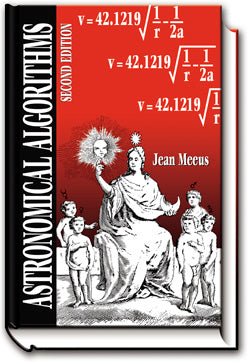
This is an introductory text that should be accessible to a reader
having a background in calculus and elementary differential equations. The
original edition (published in 1962) has been radically revised, and emphasis
is placed on computation. The numerical analysis needed for the computations is
derived, and sample programs (run on a IBM-PC) are included. There are
introductory chapters on the astronomical background and on vectorial
mechanics. Sections dealing with the problem of two bodies include the use of
universal variables, several methods (including that of Laguerre) for solving
Kepler's equation, and three methods for solving the two point boundary value
problem. The chapter on the determination of orbits includes two versions of
Gauss' method, the application of least squares and an introduction to
recursive methods. The chapter on numerical methods has been expanded, and
includes three methods for the numerical integration of differential equations,
one of which has full stepsize control. There are also chapters on
perturbations, the three- and n-body problems, the motion of the Moon
and the rotations of the Earth and Moon. The appendix includes numerical tables
and derivations of properties of conic sections that are used in the text. The
text includes several hundred problems, and suggested computer projects. The
computer listings found in the book are available separately, along with a
selection of other programs, on IBM-PC 3.5-inch diskettes.
The text is accessible to undergraduates or graduate students in
mathematics, physics, engineering or astronomy. As minimum requirements, a user
is assumed to have taken introductory courses in calculus, differential
equations and mechanics. Other topics, such as numerical analysis, are
developed in the text as needed. There is plenty of material for two semesters;
so a one semester course can be designed in many ways (even with the exclusion
of all computing).
From the Reviewers:
The select group of scientists and engineers who dedicate their
career to celestial mechanics consider the authors book of fundamental
importance. The original edition of 1962 appeared when the author worked at
Yale University with several of the giants in our field (Brouwer, Clemence,
Eckert, Hagihara, Herget, etc.). The considerable influence of the original
edition on our field is surpassed by the present second, revised and
significantly enlarged edition. The author often referred to his book as "Fun
in celestial mechanics", and while this was certainly true for the original
edition, it is even more applicable to the second edition. The significant
additions appearing in this edition emphasize computations and numerical
analysis essential in celestial mechanics. The authors inclusion of the
listing of some programs is most welcome and will help students and will save
considerable time. His use of BASIC as the language for program listing might
be a controversial selection but it is considered one of the excellent
languages for scientific computations.
The authors competence as a teacher offering a panoramic
view of his subject is best represented in the chapter dedicated to numerical
procedures. His discussion of the concepts of "respectable errors" (round-off
and truncation errors) and "blunders" shows how to lead the reader along the
beautiful but hard path of numerical celestial mechanics. The book contains
many well-selected examples and problems, offers a solid astronomical
background, gives details of physical and orbital elements of planets and of
comets, and lists basic references.
Since the first artificial satellite was placed in orbit,
initiating the space age, many introductory textbooks have appeared in the
literature. The authors book is distinguished from those of his rivals
for several reasons which make it one of the outstanding texts: clear, readable
and understandable style, emphasis on numerical approaches, offering
astronomical background and use of vector analysis. This excellent introductory
textbook is strongly recommended for undergraduate courses in celestial
mechanics, orbit dynamics and astrodynamics.
Mathematical Reviews
American Mathematical Society
A new edition of Fundamentals of Celestial
Mechanics is a welcome sight to those of us who teach this subject to
advanced undergraduates or beginning graduate students. . . One of the best
features of the original was its large variety of problems and exercises, and
the new edition has even more...The expanded sections and new material have
broadened the text's applications. . . this second edition of Danby's
Fundamentals of Celestial Mechanics will also become a classic.
Sky & Telescope magazine
This second edition has been substantially revised
and enlarged and demonstrates in a dramatic manner how the use of computers of
all sizes has allowed teachers and students alike to gain a much deeper
understanding of a subject requiring substantial numerical computation....(it)
is most certainly a valuable addition to any teacher's personal library. It is
also cheap enough for students, who are interested in the finer details of
numerical computation of orbits, to purchase their own copy.
The Observatory
Table of Contents
1. The Astronomical Background
1 1.1. Introduction
1 1.2. Some Definitions 2
1.3. Orbital Definitions 3
1.4. Keplers Laws 4
1.5. The Astronomical Unit 5
1.6. Bodes Law 5
1.7. Astronomical Observations 6
1.8. The Celestial Sphere 6
1.9. Precession, Nutation, and
Variation of Latitude 9 1.10.
The True and Apparent Places of a Celestial Object 10
1.11. The Measurement of Time 11
2. Introduction to Vectors 13
2.1. Scalars and Vectors 13
2.2. The Law of Addition 15
2.3. The Scalar Product 19
2.4. The Vector Product 22
2.5. The Velocity of a Vector 27
2.6. Angular Velocity 29
2.7. Rotating Axes 31
2.8. The Gradient of a Scalar 36
2.9. Spherical Trigonometry 37
3. Introduction To Vectorial Mechanics 41
3.1. Forces as Vectors 41
3.2. Basic Definitions 41
3.3. Newtons Laws of Motion
44 3.4. The Laws of Energy and
Momentum 45 3.5. Simple Harmonic
Motion 47 3.6. Motion in a
Uniform Field, Subject to Resistance Proportional
to the Velocity 48 3.7. Linear
Motion in an Inverse Square Field 49
3.8. Foucaults Pendulum 50
3.9. The Equation of Motion of a
Rocket, Subject to its Own Propulsion 52
3.10. Problems 53 4.
Central Orbits 57 4.1.
General Properties 57 4.2. The
Stability of Circular Orbits 59
4.3. Further Basic Formulas 62
4.4. Newtonian Attraction 63
4.5. Einsteins Modification of the Equation of the Orbit 67
4.6. The Case f(r)
= n2r 68
4.7. The Case f(r) =
m/ r3: Cotes Spirals 69
4.8. To Find the Law of Force, Given
the Orbit 71 4.9. The
Universality of Newtons Law 74
4.10. Worked Examples 78
4.11. Problems 82 5 Some
Properties of Solid Bodies 89
5.1. Center of Mass and Center of
Gravity 89 5.2. The Moments and
Products of Inertia: The Inertia Tensor 90
5.3. The Potential of a Sphere
96 5.4. The Potential of a
Distant Body: MacCullaghs Formula 100
5.5. The Field of a Homogeneous
Ellipsoid 102 5.6.
Laplaces Equation, Legendre Polynomials, Potential of the Earth 112
5.7. The Tidal Distortion of a
Liquid Sphere Under the Action
of a Distant Point Mass 117 5.8.
Ellipsoidal Figures of Rotating Fluid Masses 120 6. Chapter 6 The
Two-Body Problem 125
6.1. The Motion of the Center of Mass 125
6.2. The Relative Motion 127
6.3. The Orbit in Time 129
6.4. Some Properties of the Motion
138 6.5. The Choice of Units
146 6.6. The Solution of
Keplers Equation 149 6.7.
The f and g Functions 162
6.8. The Initial Value Problem I
165 6.9. Universal Variables
168 6.10. The Initial Value
Problem II 178 6.11. The
Two-Point Boundary Value Problem IApplication of
Lamberts Theorem 180 6.12.
The Two-Point Boundary Value Problem IIGauss Method 191
6.13. The Two-Point Boundary Value
Problem IIIThe Method Herrick
and Liu 195 6.14. Some
Expansions in Elliptic Motion 198
6.15. The Orbit in Space 201
6.16. The Geocentric Coordinates
206 6.17. The Effects of
Planetary Aberration and Parallax 207
6.18. Projects 209
7. The Determination of Orbits 213
7.1. Introduction 213
7.2. Laplaces Method 217
7.3. Gauss Method 226
7.4. Hergets Method for a
Preliminary Orbit Using More Than
Three Observations 235 7.5. The
Differential Correction of Orbits 238
7.5.1. Projects 244 7.6. Using a
Previous Estimate: Recursive Methods 246 8. The Three-Body
Problem 253 8.1. The
Restricted Three-Body Problem: Jacobis Integral 253
8.2. Tisserands Criterion for
the Identification of Comets 254
8.3. The Surfaces of Zero Relative Velocity 255
8.4. The Positions of Equilibrium
260 8.5. The Stability of the
Points of Equilibrium 262 8.6.
The Lagrangian Solutions for the Motion of Three Finite Bodies 266
8.7. Problems 270 9. The
n-Body Problem 273
9.1. The Center of Mass and the
Invariable Plane 273 9.2. The
Energy Integral and the Force Function 274
9.3. The Virial Theorem 276
9.4. Transfer of the Origin: the
Perturbing Forces 276 9.5.
Application to the Solar System 278
9.6. Problems 280
10. Numerical Procedures 283
10.1. Differences and Sums 283
10.2. Interpolation 285
10.3. Differentiation 290
10.4. Integration 291
10.5. Errors 293
10.6. The Numerical Integration of
Differential EquationsRunge-Kutta
Methods 296 10.7. The Numerical
Integration of Differential EquationsA Multistep
Method for First-Order Sys-tems 302
10.8. The Numerical Integration of
Differential EquationsSystems of
Second-Order Equations 306 11. Perturbations 315
11.1. Introduction 315
11.2. Cowells Method 319
11.3. Enckes Method 320
11.4. The Osculating Orbit 322
11.5. The Effects of Small Impulses
on the Elements 323 11.6. The
Equation for e
327 11.7. Modifications When
Components Are Tangential and
Normal-Drag-Perturbed Orbits 328
11.8. Hansens Method 331
11.9. The Equations in Terms of ¶R , ¶a etc. 331
11.10. Substitutions for Small
e or i 337
11.11. The General Approach to the Solution of Lagranges Planetary
Equations 337 11.12. The
Disturbing Function 339 11.13.
General Discussion of the First-Order Solution of the Planetary
Equations 341 11.14. Secular
Perturbations 343 11.15. The
Motion of a Satellite in the Field of an Oblate Planet 345
11.16. The Computation of the
Variations of the Elements 349
11.17. The Activity Sphere 352
11.18. General Methods 353
11.19. Problems 359 12. The Motion of the Moon
371 12.1. Introduction
371 12.2. The Perturbing Forces
372 12.3. The Perturbation of
the Nodes 374 12.4. The
Perturbation of the Inclination 376
12.5. The Perturbations of ? and e
377 12.6. The Variation 379
12.7. The Perturbation of the Period
and the Annual Equation 380
12.8. The Parallactic Inequality 381
12.9. The Secular Acceleration of
the Moon 382 12.10. Theories of
the Motion of the Moon 384
12.11. Problems 385 13. The Earth and its Rotation 389
13.1. The Eulerian Motion of the
Earth 389 13.2. The Couple
Exerted on the Earth by a Distant Body 391
13.3. The Couples Exerted on the
Earth by the Sun and Moon 392
13.4. The Lunisolar Precession 395
13.5. Nutation 397
13.6. Problems 399 14.
Chapter 14 The Moon and its Rotation 401
14.1. Cassinis Laws 401
14.2. The Eulerian Equations 401
14.3. The Libration in Longitude
403 14.4. Other Oscillations
405 14.5. Problems 411
Appendix A. Properties of Conics 413
A.1. General Properties 413
A.2. The Ellipse 416
A.3. The Parabola 418
A.4. The Hyperbola 420
A.5. Pole and Polar 422
Appendix B. The Rotation of Axes 425 Appendix C. Numerical Values
427 C.1. Orbital
Elements of Planets 427 C.2.
Satellites: Orbital and Physical Data 430
C.3. Physical Elements of Planets
432 C.4. The Earth 433
C.5. The Moon 434
C.6. The Sun 435
C.7. Physical Constants 435
C.8. Miscellaneous Data 436
Appendix D. Miscellaneous Expansions in Series 437
D.1. f and g
Series 437 D.2. Elliptic Motion
437 Appendix E. The Solution of Linear Systems 439 Appendix F.
The Generation on the Computer of Gaussian Deviates 443 Appendix G. Some
Orbits of Comets and Minor Planets 445 Appendix H. The Greek Alphabet
449 Appendix I. Random Variables, and Least Squares 451 Appendix J.
Notes on Hamiltonian Mechanics 457
J.1. Elements of Lagrangian
Mechanics 457 J.2.
Hamiltons Equations 458
J.3. Canonical Transformations 460
J.4. Canonical Transformations
Defined by Functions 462 J.5.
The Hamilton-Jacobi Equation 463
J.6. The Problem of Two Bodies 464
J.7. Perturbed Motion 465
References and Bibliography 469 Index 477
OPTIONAL IBM-PC PROGRAMS for FUNDAMENTALS OF CELESTIAL
MECHANICS
One 3.5-inch 720K(MS-DOS) diskette(s), 12 Ozs. ship wt. $15.95.
The diskette contains the same listings of the IBM-PC BASIC programs found in
Fundamentals of Celestial Mechanics and they will run without a
compiler. Also included on the diskette is either a set of programs
written in Turbo Pascal (version 3) or Turbo BASIC. Specify language
when ordering. Source code is providedyou will need the
appropriate Borland compiler to run these programs. The programs fall
into three categories.
- 1. Procedures that are used, or could be used in other
programs.
- 2. Programs that are concerned with computations related to
orbital motion.
- 3. Programs that have been designed for use as demonstrations.
The second category is closely related to the text, Fundamentals
of Celestial Mechanics, second edition. In that text, listings of several
programs are given in IBM BASIC. All of these programs appear here, in Pascal,
and several additional programs have been added.
Many programs have procedures in common, such as those for
generating Stumpff functions, or for solving Kepler's equation in universal
variables. These procedures appear on the diskettes as separate files, and are
added to the relevant programs by "include" statements: for instance, $I
Kepler would cause the file Kepler to be added to the program. The two
diskettes include the 18 program listings form Professor Danby's Fundamentals
of Celestial Mechanics and over 80 demonstrations or procedures.
Copyright ©1998 Willmann-Bell,
Inc. All rights reserved. |