|
Book |
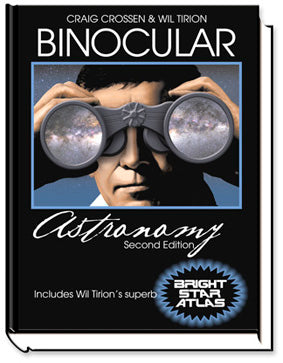
Binocular Astronomy
This book and a pair of binoculars are all you need to begin observing the night skystars, open and globular clusters, bright and dark nebulae, galaxies, and much more. The binoculars need not be expensive! Everything described in Binocular Astronomy was viewed by the author using a pair of $40 binoculars he purchased from Sears & Roebuck in 1978. The chances are good that you now have or can borrow a pair of binoculars that will do very nicely. You don't have to buy an atlas. Binocular Astronomy includes Wil Tirion's 10-map The Bright Star Atlas 2000.0 . This atlas plots practically every star visible with the naked eye plus hundreds of deep-sky objects. Tirion has also created 24 detailed finder charts plus a set of seasonal finder charts. Also included are 24 photographs (most are wide field) and 37 Tables. Not only does Binocular Astronomy help you locate objects but it explains what they are and how they fit into our understanding of the universe. While there is great aesthetic beauty in the night sky, there is also the Science of Astronomy. You can easily skip over the technical jargon, but you will probably soon find yourself recognizing a star's age by its color, understanding its place in our Galaxy by its distance and much else. Binocular Astronomy will show you why most experienced amateur astronomers think that binoculars should be the first optical instrument for the beginner and why they are of value to even seasoned observers. What the Reviewer's Had to Say . . .
The attention to detail in the observing information bears the
hallmark of one who really knows his way around the sky. I would recommend it
not so much as a general guide to binocular observing, but as a first-class
deep-sky atlas both for observers with binoculars and those with small
telescopes.
This reviewer believes that any armchair astronomer who
reads Binocular Astronomy will be tempted to change his/her status to
one of active observer. From this comment and that of the books title it
is easy to ascertain that Binocular Astronomy is about active observing
and for this reason alone it is welcome. By producing this book, both Crossen
and Tirion have performed a service for those who may own a pair of binoculars
and yet wish to experience the joy of observing some of the night skys
brighter objects. Moreover, by the books content and the style,
Binocular Astronomy is of value to both the novice and the seasoned
observer.
it is complete and well illustrated, with descriptions of
hundreds of objects in the sky that will appeal to interested beginners and
advanced observers of all ages. Exactly 105 years ago a New York newspaperman named Garrett P. Serviss published Astronomy with an Opera-Glass, a little book celebrating the usefulness of modest, everyday optical aids. It remained in print for more than 75 yearsas its message took nearly that long to catch hold. But by the 1960s and 70s, wise amateurs had learned to tout binoculars, not a telescope, as the beginners best route into astronomy. By the 1980s advanced amateurs werent ashamed to say that they used binoculars a lot themselves .Binocular Astronomy is a glorious travelogue of the deep sky as surveyed by Craig Crossen with a pair of cheap Sears 10x50sthe sort of instrument anyone can afford and many households already have in the back of a closet. Crossen describes about 250 interesting objects at some length, weaving in not just their visual appearance but often their astrophysical significance and observational history, including a lot of constellation lore. In these respects the book shines. Unlike many popular authors who copy each others mistakes, Crossen has done graduate work in modern astrophysics and has researched the ancient constellations from original sources in Syria and Jordan. (He is currently completing a book on constellation and star-name history.) Nor is he afraid to get personal. "It has always seemed particularly appropriate to me," he writes, "that during the warm and humid nights of mid-summer, when the moist southern winds carry the fragrances of growing things and the sounds of frogs in the marshes, that something with the name The Lagoon should slowly drift over the southern horizon like a beacon of the equatorial jungles and the South Sea islands." Binocular Astronomy includes the excellent 6th-magnitude charts of Wil Tirions Bright Star Atlas covering the whole sky. These are supplemented throughout the text by many large, clear, more detailed finder charts by Tirion, including double-page maps to magnitude 7.5 running along stretches of the galactic equator. These are also some useful wide-field finder photographs. Being oriented towards readers with relatively modest glasses, Binocular Astronomy tells more about the fewer objects it covers. Theres also an excellent beginners section on sky motions, constellation finding, and basic observing techniques.
This book reminds me of Burhnams Celestial
Handbook (which Crossen credits for making him an amateur astronomer), and
like Burnhams when it came out, it became my bedtime reading. Copyright ©1998 Willmann-Bell, Inc. All rights reserved. |
|