|
Book Categories:


|
|
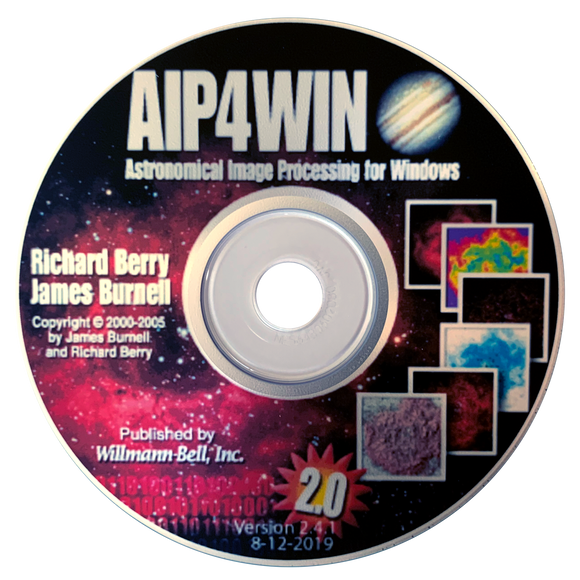
Handbook of Astronomical Image Processing (HAIP)
and its integral
AIP for Windows 2.0 image processing software (AIP4Win2.0)
Regular Retail Price $99.95
Upgrade Price $59.95* (registered owners only)
Now
AIP4Win2.0 loads and processes both scientific grade ccd images and hundreds
of different consumer digitial camera RAW files. (click
here for list)
AIP4Win2.0
On-line Registration
From
the Sky and Telescope Magazine Review
May 2006 Issue
Because
the second edition of this book, like the first, is bundled with the well-regarded
image-processing software AIP4Win (now also updated), it's easy
to understand why some people mistakenly think that the book is a user's
manual for the program.
It's not! Rather, it's the finest book to date covering
the entire gamut of digital astrophotography. It
should be mandatory reading for those shooting digital pictures of the
Moon, planets, or deep-sky objects regardless of what camera or software
they use. And while it's certainly a book aimed at practitioners,
The Handbook for Astronomical Image Processing is also for curious
individuals who want an in-depth look at what's behind the stunning images
being turned out by today's amateur astronomers images that in
many cases exceed the beauty and detail of the finest professional work
done in the days of emulsion-based astrophotography.
Think of any cryptic term you've seen attached to a digital photograph,
be it full-well capacity, wavelet filtering, or some alphabet-soup acronym,
and you'll likely find a clearly written description in this book. Although
there's no shortage of mathematical equations, in many cases you can bypass
them and still understand the concepts more than well enough to use them
to improve your imaging and image-processing techniques. Whether
your interest is pretty pictures or scientific analysis, you'll find a
wealth of useful information between the covers.
DENNIS DI CICCO
Senior Editor
About
this book and software...
This second edition of the Handbook of Astronomical Image Processing
(HAIP) and its integral AIP for Windows 2.0 image processing software
(AIP4Win2.0) addresses many important changes that have taken place in
astronomical imaging since the publication of the first edition. Today's
affordable astro-imaging capable digital single-lens-reflex cameras (DSLRs),
the growing power of personal computers, and the proliferation of telescopes
and imaging accessories has brought imaging capabilities within the reach
of practically every amateur astronomer - and this second edition of the
Handbook plus AIP4Win 2.0 is ready, willing, and able to
assist every observer in making great astronomical images.
In the Handbook, we amplified the original chapters on astronomical
equipment and imaging techniques, revised our discussions of astrometry
and photometry to reflect the steady growth in these scientific fields,
and expanded tutorials in the back of the book to help you get up to speed
quickly. On the accompanying CDROM (found on the inside back cover) you
will find hundreds of megabytes of sample images you can use to learn
techniques such as image registration and stacking that guarantee good
results even from those living with suburban and urban skies. Also new
are comprehensive chapters on color imaging with astronomical CCD cameras
and processing color images from digital cameras, and photon-counting
fundamentals every serious astro-imager needs to know. Detailed chapters
cover these fundamental topics:
-
Basic imaging: How the light that falls on your CCD becomes an
image. Covers image formation, cameras, telescopes, detectors, sensor
geometry, image capture, field of view, and angluar coverage.
- Counting
Photons: "Astronomy is about counting photons...." Covers
signal, noise, the signal-to-noise ratio, the Poisson and Gaussian distributions
and why they matter, making better pictures by summing images, and how
dark frames and flat frames effect the signal and noise in your images.
- Digital
Image Formats: Covers the file formats that astronomers use, including
FITS, TIFF, BMP, and JPEG. Learn file format basics, how your image
data is arranged inside the file on your computer's hard disk.
- Imaging
Tools: All about sensors, optics, cameras, and telescopes. Explains
how to calculate the field of view and resolution of your system, telescope
optics for imagers, auxiliary optics, mounts, drives, tracking, filters,
and how to recognize and correct common equipment problems.
Imaging Techniques: "Good equipment is only half the story!"
Covers the techniques that experienced imagers use to obtain high-quality
images. Includes polar alignment, good guiding, critical focus, correct
exposure, darks and flats, light boxes, and special considerations for
DSLR cameras.
- Image
Calibration: Examines the nitty-gritty details of image calibration.
All about bias, dark noise, flat-fielding, standard and scalable darks,
cosmic rays, making master dark frames, flats, standard calibration
protocols, and defect mapping and correction.
- Image
Analysis: "Locked within the numerical values that make up
a calibrated CCD image is a staggering amount of information."
Covers pixel coordinates, pixel value, image statistics, the image histogram,
feature analysis, the centroid, distances, and image profiles.
- Measuring
CCD Performance: How to measure the performance of your CCD camera.
Discusses goals in measuring CCD performance, how to shoot test images,
and the determination of bias level, dark current, gain, linearity,
and readout noise.
- Astrometry:
Asteroid hunters measure the postions of new-found objects using astrometry.
Covers the theory behind finding right ascension and declination from
a CCD image, practical astrometry, and the uses of astrometry.
- Photometry:
Amateur observers now work side by side with professional astronomers
to measure the variations of variable stars, supernovae, asteroids,
and comets using the CCD to capture precise measures of brightness.
- Spectroscopy:
An emerging area for amateus astronomers brought to you by the CCD
camera. Covers spectra and spectrographs, gratings, prisms, slit- and
slitless systems, and the properties and meaning of stellar spectra.
- Geometric
Transforms: Covers translation, rotation, scaling, flipping, cropping,
floating, and resampling. Demystifies the basic geometric operations
used in astronomical image processing.
- Point
Operations: Learn how software converts the pixel values your CCD
camera captures into the sparkling images you see in popular magazines
and amateur websites. Remapping, transfer functions, linear, log, and
exponential scalings explained. Covers endpoint specification and histogram
specification.
- Linear
Operators: All about one of the most useful tools in the amateur
astronomer's digital toolbox. Describes how digital convolution performs
crispening, sharpening, smoothing. Learn about low-pass and high-pass
kernels, Sobel, Kirsch, and Prewitt operators, and that most useful
of linear tools: the unsharp mask.
- Non-Linear
Operators: Non-linear operators perform useful services like cleaning
up noisy images. Cover rank-order processes, the median filter, local
adaptive sharpening, noise filters, and morphological operators.
- Image
Operations: Multi-image operations are the basic tool for making
superior astro-images. Covers image math, median-combine stacking, image
registration, blinking, and track-and-stack image summing.
- Images
in Frequency Space: Unlocks the mysteries of the Fourier Transform
and image processing in the spatial frequency domain. These powerful
techniques used by profession astronomers are now accessible to amateurs
- Wavelets:
Explores the hottest new image processing and restoration techniques.
Covers the wavelet transform, the inverse wavelet transform, spatial
filtering, the wavelet noise filter, and iterative filtering techniques.
- Deconvolution:
Deconvolution attempts to restore images degraded by a turbulent atmosphere,
poor telescope optics, and tracking errors. Discusses algorithms used
to sharpen Hubble Space Telescope images, how they work, and how amateurs
can use them.
- Building
Color Images: You've seen fantastic astro-images on the web and
in popular magazines and books. Learn how astronomers capture and build
color images from multiple exposures through different color filters.
Covers the colors of astronomical objects, luminace, chrominance, color
space, white balance, G2V stars, RGB and LRGB color image capture.
- Processing
Color Images: The digital SLR camera has done much to bring color
imaging to the average amateur astronomer. Explains the Bayer array,
color image bit depth, noise, dark current, vignetting, calibration,
image stacking, and luminace enhancement techniques.
NOTE
The Handbook complements and extends what you learn, and is NOT a software
manual for AIP4WIN2.0. AIP4WIN's manual is a massive on-line help file
always ready to give you answers at a moments notice, a context-sensitive
on-line guide to the software. The Handbook and AIP4Win 2.0 are sold together
as a complete package. Under no conditions do we allow the software to
be split from the book or the book to be separated from the software.
To get you off and running
quickly the authors have provided 13 tutorials to introduct you to AIP4Win2.0
and to provide concrete demonstations of the subjects covered in The
Handbook of Astronomical Image Processing
- Image
Enhancement: Discover how to extract detail from otherwise bland
images. More than producing "pretty pictures," using the techniques
will demonstrate to your enhanced details and show structures that,
due to their low contrast, might otherwise be invisible.
- Processing
Multiple Images: Here is power at your fingertips! Calibrate an
entire imaging session's worth of images at one time automatically.
Align and enhance a set of images in preparation for creating a movie.
Align and combine a group of images to create a single, "deeper"
image. Process hundreds of planetary images.
- Image
Registration and Blinking: Registration and blinking are key tools
in searching for asteroids and patrolling for supernovae.
- Building
Color Images: Learn how the "Join Color Tool" helps you
to create stunning color images hassle-free from sets of red/green/blue
filtered images.
- Wavelet
Noise Filtering: Experiment with one of the newest and hottest image-processing
technologies. Wavelets are used by professional astronomers to analyze
images from spacecraft.
- Deep
Sky Images: Learn the best ways to process a wide variety of deep-sky
images, including the calibration and enhancement of a typical track-and-stacked
deep-sky image.
- Planetary
Images: In this tutorial, you process an outstanding image of Jupiter
using brightness scaling, unsharp masking, and deconvolution tools..
For
a sample of this books text and contents see:
Table of Contents
Preface to First and
Second Editions
Chapter 1
Index
AIP4Win 2.0 retains its highly acclaimed interface but with significantly
increased capabilities. Now, AIP4Win 2.0 processes all image data
in 32-bit floating-point format to insure that you will not lose even
one photon of precious light. Atop these powerful 32-bit floating-point
core routines, we built an image display engine capable of showing you
images in both color and black-and-white, from a minimum of 10% to a maximum
of 1600% size. What you can load into AIP4Win2.0 and display is
now limited only by the memory on board your personal computer - and this
capability is not limited to black-and-white images - AIP4Win 2.0
now has a suite of sophisticated software tools for loading and processing
astronomical color images plus new functions that predict the results
you'll get when you make camera images and combine them in software.
AIP4Win 2.0 now has the ability to perform wavelet image enhancement,
wavelet image analysis, and wavelet noise reduction - techniques so new
they're not even mentioned in the classic works about image processing.
The deconvolution procedures have been enhanced so not only do they run
faster than ever before, but they also produce superior image enhancements.
Also new is a suite of editing functions to fix bloated star images, patch
image flaws, and smooth bothersome sky gradients along with an image display
control that helps you visualize all the information - and beauty - contained
in your digital images. In short, AIP4Win 2.0 is a full-featured
image-processing program designed and optimized for loading, processing,
and displaying astronomical images. Here are a few of its capabilities:
- Load and process 16-bit, 32-bit, and 64-bit floating-point and integer
images from all makes of astronomical CCD camera.
- Load and process RAW, CRW, and NEF files from popular digital single-lens
reflex cameras.
- Display, scroll, and magnify images from 10% to 1600%.
- Image file size is limited only by your computer's available memory.
- Display pixel values, image statistics, histograms.
- Edit bloated stars, blooming trails, sky gradients, hot spots, and
cosmic ray tracks.
- Full-featured image calibration functions include bias subtraction,
automatic dark-frame matching and subtraction, flat-fielding, defect
correction. Calibrate images individually, in groups, and during image
stacking.
- Perform astronomical astrometry and photometry on images; determine
celestial coordinates to sub-arc second accuracy and magnitudes with
the millimag precision.
- and at this point you normally see "Plus much, much , more .
. ." but there is! Click here
for 5 pages of much, much, more.
For
best performance, AIP4Win2.0 requires the following:
- Operating
system: Windows 98SE or later
- CPU
and RAM: For images ~1 megapixel monochrome images, 128MB of RAM and
a Pentium III 400 MHz provide adequate performance; for 6 megapixels
DSLR images, 512MB of RAM and a Pentium IV 2 GHz machine is desirable.
However, as is true with all image processing programs a faster CPU
and more memory can significantly enhance speed. Increased memory, by
itself, can often significantly speed things up.
- Display:
1024 x 768 min., 1600 x 1200 or better preferred.
- CDROM
reader: 16x or better (copy files to HDD).
- Hard
Disk: 20 MB free disk space for the program, plus storage for your image
files (recommended minimum 20 GB).
When
you purchase the Handbook of Astronomical Image Processing, you
receive one CDROM containing AIP4Win 2.0 that is licensed for use
on one personal and a portable computer if you own one. AIP4Win 2.0
requires validation via the web (or telephone) within 30 days of installation.
Once validated, you also receive the right to updates (free downloads
via the web) and upgrades (for a fee) as they become available.
SEE ALSO:
Digital Astrophotography - Imaging the Universe with a Digital Camera
© 1995-2005 Willmann-Bell, Inc. All Rights Reserved.
P.O. Box 35025, Richmond, Virginia 23235 USA Voice: (804) 320-7016
Fax: (804)272-5920
|