Book
Categories:

atlases
ccds/astrophotog
handbooks
math/celestial mech.
photoelectric photometry
almanacs
telescope making
history
navigation

shopping cart
Home
New
Hypersky

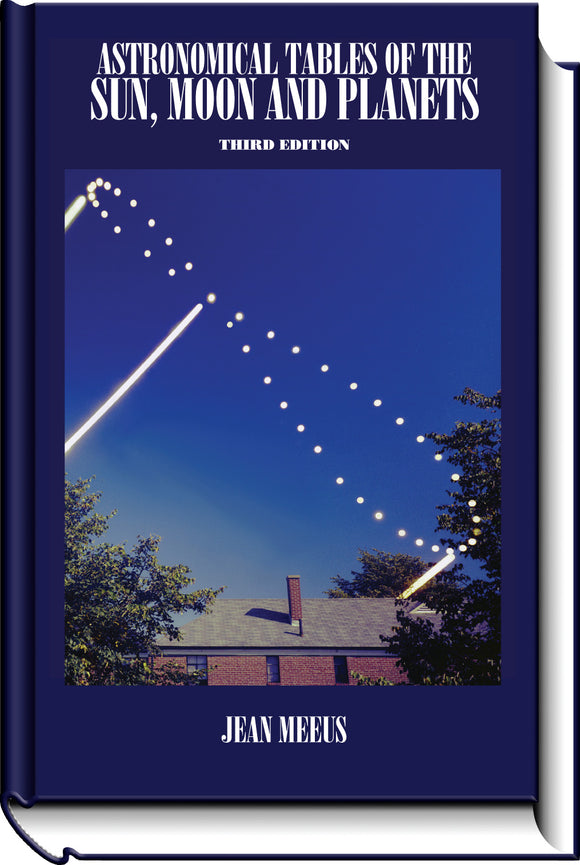
Astronomical Tables Of The Sun, Moon And Planets

Meeus, 2nd Edition, 9.00" by 6.00", 491 pages, hardbound, published 1995, 2 Lbs. 10 Ozs. ship wt. $24.95

Add to cart

AstronomicalTalbes.jpg (58211 bytes)Here, in one handy reference, are many of the past and future predictable astronomical events of interest to amateur and professional astronomers. Among the subjects covered are planetary phenomena 1990–2020 (inferior and superior conjunctions of Mercury and Venus, greatest elongations of Mercury and Venus, oppositions of Mars, Jupiter, Saturn, ranus, Neptune and Pluto, etc.) oppositions of Mars 0–3000, Equinoxes and Slostices 1–3000; phases of the Moon 1970–2050; occultations of planets and bright stars 1990–2020; sunspot activity 1749–1994 and many other tables (calculating the Julian Day, perpetual calendar, dates of Easter Sunday, Jewish Calendar, Moslem Calendar and much, much, more.

“This is a magnificent book. It must remain the standard for the coming century at least, and no serious astronomical library will be complete without it. Jean Meeus has rendered astronomy a notable service.”
                – Journal of the British Astronomical Society

…is just a wonderful compendium of tabular information, and as such, one of the rather frequently used references in my office. For example, there is an extensive tabulation of time of equinoxes and solstices from A.D. 1 to the year 3000; his table is now used by our local classical music station, which regularly observes these cycles with appropriate musical selections. Most people assume that the March equinox generally falls on the 21st, which it did in the first half of our century, but inspection of Meeus’ tables shows that now and until the 24th century, the March equinox comes most frequently on the 20th. If you want to know the phases of the moon, conjuctions or oppositions of the planets, or past sunspot numbers, here is a good place to look.
                              Journal for the History of Astronomy

The following is from Roger W. Sinnott's Foreword:

To find out the Moon's phase or which bright planets are up, most people depend on TV weather forecasters or the night-sky columnist of the local newspaper. Such commentators, in turn, rely on astronomy magazines and almanacs. But these publications tend to focus on the here and now—what's going to happen tonight, next month, or later in the current year—with little regard for long-term trends.

To understand the sky better, amateur astronomers often expand their horizons with computer programs that plot sky objects for any date and time in the past or future. The better software packages are reasonably trustworthy over a span of many centuries. But there's a catch. To look for a specific type of planetary grouping, a transit of Venus across the Sun's disk, or the best possible observing conditions for Mars, you need to know the approximate date of the event.

In fact, some of the most obvious astronomical questions are not about what happened (or will happen) on a certain date, but just the reverse. When was the last time Venus appeared so close to Jupiter? In what year will Saturn's rings be edgewise again? When can I see the Moon occult Antares from my backyard? Planetarium-type programs are a fun way to attack such puzzles, but you could find yourself staring at the video monitor while the machine cycles through the days, months, and years. To discover an event's date more efficiently calls for astronomical insight, special programming tricks, and a thorough grasp of the clockwork of the heavens—or, better yet, this book!

For example, I get frequent phone calls from calendar makers. They need to know the exact dates of lunar phases and the start of spring, summer, fall, and winter several years in advance. No doubt someone has said, “Just call Sky & Telescope.” What these people don't know is where I always turn for the information they seek. The first edition of Jean Meeus's Astronomical Tables appeared in 1983, and it is one of the few books I've kept within arm's length at my desk ever since. In return for supplying this arcane information to the callers, I've also acquired lots of free calendars.

Early in 1994 Meeus wrote me that his first project upon retirement would be to recalculate everything for an update of this book. Months later, when I saw the page proofs, I grabbed my dog-eared 1983 edition to compare the calendrical data I had trusted so long. The newly calculated times of the lunar phases are indeed different - by typically 1 to 3 seconds! The starts of the seasons starts have been refined too, by less than a half minute for recent times but by 10 minutes or so during the era of the Roman empire. Thus I gained a feel, not only of the subtle improvements made recently in astronomers' knowledge of solar-system dynamics, but also of the great attention to detail that has earned Meeus worldwide renown in calculations of this nature. At the same time, he has extended most tables of the book at least 15 years further into the future.

Who, then, will use this book? To many skywatchers it is an observing guide for the better part of a lifetime. All the most spectacular planetary conjunctions are listed here. The dates of greatest elongation of Mercury and Venus from the Sun tell when these two inner planets are most readily viewed with a telescope. Down through years, observers have confirmed a curious finding by Johann Schrater in the late 18th century, that Venus and Mercury appear just half illuminated (at “dichotomy”) several days before an evening elongation and after a morning one, rather than at the elongation itself. For an outer planet like Mars, the opposition date is very close to the time it presents the largest possible disk for telescopic study. Oppositions are also good times for spotting the brighter asteroids in binoculars. Those who watch Jupiter's moons dip in and out of eclipse will enjoy page 58 of this book, listing the intervals when Callisto avoids the giant planet's shadow entirely. At the endpoints of these intervals, rare partial eclipses may be seen.

A major section (pages 217–346) deals with lunar occultations, those spectacular moments when the Moon hides and later uncovers a bright star or planet. No ordinary almanac is much help with the exact times to look for these events because they depend so much on the observer's geographic location. The star may wink out in Montreal almost an hour after it does in Denver, or the Moon may miss the star completely. Commercial software can be a poor guide too, as I discovered a few days before a recent occultation of Spica. A flurry of messages on the CompuServe computer network warned that various programs differed in their predictions by three to five minutes, even for a specific latitude and longitude. Later, when some actual timings were posted, I confirmed that my secret source—the Besselian elements in this book's first edition—yielded times that were correct to within 2 seconds. Meeus has now extended the tables of occultation elements 20 years further, including on page 234 a Basic program to aid with the calculations.

Even armchair astronomers will find much of interest here. The 11-year sunspot cycle, tabulated in such detail on pages 347–382, is more than a numerical curiosity. Years with high sunspot counts are frequently the years when spectacular aurorae burst upon the night sky and shortwave communications undergo brief disruptions. Years with the fewest sunspots produce solar eclipses with the longest coronal streamers. Many people have tried to find correlations between sunspots and the weather. Some have even wondered if earthquakes and volcanic eruptions are more likely during perigees of the Moon, when the tidal stresses within our planet are largest. The data in this book can play a vital but impartial role in queries of this sort, providing a sound basis for rejecting the wilder speculations.

Anyone curious how this book's calculations were done should consult the same author's Astronomical Algorithms (Willmann-Bell, 1991). Computer programmers are having a bonanza with that impressive work, but for countless other astronomy buffs it is equally rewarding to ponder the outcome of such calculations, compiled by a supreme master of the art.
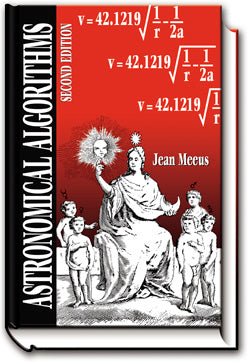
Table of Contents

Note on Time Reckoning
Part 1: Planetary Phenomena 1990–2020
     I. Inferior conjunctions of Mercury
    II. Superior conjunctions of Mercury
    III. Greatest elongations of Mercury
    IV. Inferior conjunctions Of Venus
    V. Superior conjunctions of Venus
    VI. Greatest elongations of Venus
    VII. Oppositions of Mars
    VIII. Oppositions of Jupiter
    IX. Oppositions of Saturn
    X. Oppositions of Uranus
    XI. Oppositions of Neptune
    XII. Oppositions of Pluto
    XIII. Conjunctions of the superior planets with the Sun
    XIV. Earth in perihelion and aphelion
    XV. Mars in perihelion and aphelion
    XVI. The outer planets in perihelion and aphelion
    XVII. Mars in ascending node and in descending node
    XVIII. Zero and extreme heliocentric latitudes of the outer planets
    XIX. Zero and extreme declinations of the planets
    XX. Extreme declinations of the Sun
    XXI. Planetary Conjunctions (geocentric)
    XXII. Close planetary conjunctions
    XXIII. Quasi-conjunctions
    XXIV. Heliocentric conjunctions between the outer planets
    XXV. Oppositions of bright minor planets
    XXVI. Eclipse series of Callisto
    XXVII. Passages of Earth and Sun through the ring-plane of Saturn
Part 2: Oppositions of Mars 0–3000
Part 3: Equinoxes and Solstices 1–3000
Part 4: Phases of the Moon 1970–2050
Part 5: Occultations of Planets and Bright Stars 1990–2020
Part 6: Sunspot Activity 1749–1994

Part 7: Other Tables
    I. Table for calculating the Julian Day
    II. Perpetual Calendar
    III. Date of Easter Sunday, 1583–2119
    IV. Jewish Calendar, 1990–2020
    V. Moslem Calendar, 1990–2020
    VI. Perigree and Apogee of the Moon, 1990–2020
    VII. Table for calculating the illuminated fraction of the Moon’s disk
    VIII. Table for calculating the selenographic colongitude of the Sun
    IX. Inferior conjunctions of Venus
    X. Superior conjunctions of Venus
    XI. Oppositions of Jupiter, 0–2500
    XII. Oppositions of Saturn, 0–2500
    XIII. Transits of Mercury
    XIV. Transits of Venus
    XV. Solar Eclipses, 1951–2050
    XVI. Lunar Eclipses, 1951–2050
    XVII. Equinoxes and Solstices on Mars
    XVIII. Positions of bright zodiacal stars
    XIX. Conjunctions of the Sun with bright stars
Bibliography
Index

Copyright ©1998-1999 Willmann-Bell, Inc. All rights reserved.