Telescope Making Supplies
Downloads and Updates Software Registration Contact Information Shopping Cart


For 36 years, we've offered the finest in Mirror Kits, each with two top-quality Pyrex blanks.

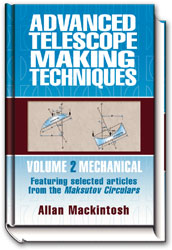
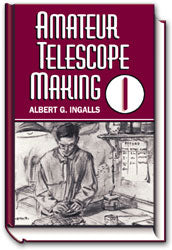
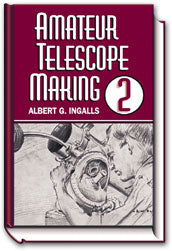
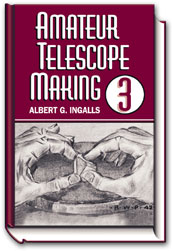
Since the advant of the Amateur Telescope Making movemen in the United States lead by Russel W. Porter and Albert G. Ingalls in the 1920s thousands have made telescopes with not much more than their hands, two Pyrex or glass blanks, abrasives, pitch, polishing compounds and a book describing the simple steps. Young and old, the very rich and the not so rich have all successfully turned their hands and minds to the task.

Willmann-Bell offers a full range of books, abrasives, polishing compounds, waxes, and Pyrex to help you quickly and easily make a first-class telescope. Unlike others, our selection is not limited to fast moving items, but also includes the hard-to-find. It is no longer necessary to search far and wide to find optical quality supplies. With Willmann-Bell as your supplier, your computer or your mail box is as far as you have to go to find complete, fast service.

Note: Due to the risk of contamination abrasives, polishing compounds and pitch are not returnable.

Check and compare what you get before you buy any kit, ours or a competitor’s. Feature for feature, for quality and value you’ll find that you simply can’t beat a Willmann-Bell Experience Proven Kit.TM
Two Fine Annealed Pyrex Blanks: With the Pyrex supplied in our kit you have a total of 4 surfaces to choose from. The best others offer is 2, whether they have two raised rim Pyrex blanks or a single Pyrex blank and a glass or ceramic tool. Further, since both blanks are the same thickness and are made of the same material, flexure, temperature and differing wear rates are all minimized or nonexistent. Finally, there is never any risk of hot pitch breaking the tool as can happen with glass.

Fast Cutting Silicon Carbide: The average 6 inch mirror is hollowed out about a tenth of an inch at the center. When you consider the amount of material that has to be removed, fast-cutting, long-lasting silicon carbide makes sense. For more details on this excellent abrasive consult the abrasive section.

White Aluminum Oxide Lapping Powders: Final grinding or lapping is the key to faster, easier polishing. White aluminum oxide gives you the finest possible surface because of its unique purity and discus shaped particles that plane the glass away rather than chipping and gouging like other abrasives. To our knowledge no other kit maker offers you this unique product.

Fast Polishing Cerium Oxide: For years red rouge was used to polish and figure mirrors. While capable of producing excellent surfaces it is slow and very messy. Cerium Oxide is faster and much cleaner.

Micro-Facet Netting: Netting has been used by professionals for years but seldom by amateurs. It makes the lap much more responsive and promotes a smoother surface since the pitch can flow over a smaller area without restriction.

Tempered Burgundy Pitch: This special mixture has the ideal flow rate to ensure an accurate surface with no turned edge. Never needs straining.

Pure Packaging: Many suppliers pack their abrasives in shaker-top containers. While this appears to be a real advantage to first-time users, the experienced know that it is of dubious value. First, you will be using a large range of abrasive sizes; just as you learn to control one size you will be moving on to an even smaller and harder to control size. Second, the closures do not completely seal, which often leads to contamination in shipment and use. Professional workers either make a water-abrasive slurry and apply it with a brush, or they spoon the abrasive and cover the container with a small sheet of glass. Either way the exact quantity is placed precisely where it is desired. Therefore we seal our abrasives in a heavy-duty plastic bag to ensure its purity, and we recommend that you do what professionals do—transfer it to a small bowl and apply by spoon or make a slurry and apply it by brush. Never open a finer grade abrasive package until you are about to use it and have done a through cleanup of your work area and changed your clothes.

NOTE: Stocks of Pyrex are rapidly approaching an end. We are currently exploring other low-expansion glass possibilities.

Willmann-Bell Pyrex® Mirror Kits*
Size (inches)
Price (US$)
 
4.25
$59.95
Out-of-Stock
6.00
$75.95
Out-of-Stock
8.00
$145.95
Out-of-Stock
10.00
$312.95
Out-of-Stock
12.50
$579.95
Out-of-Stock
*Strain Birefringence: 10 millimicrons, or less

This is a “kit” of the abrasives, polishing compound (cerium oxide) and pitch that we package with our complete mirror kits. We offer these for people who have their own glass but nothing else.

Willmann-Bell Abrasive,
Polishing Compound & Pitch Kits
Mirror Size (inches)
Price US$
 
4.25
$34.95
6.0
$39.95
8.0
$58.95
10.0
$81.95
12.5
$99.95

Each blank has straight sides, few or no bubbles, and is fine annealed.
They are ideal as primary and secondary mirrors, small flats and test plates
.


NOTE: Stocks of Pyrex are rapidly approaching an end, quantities are limited to inventory on hand. We are currently exploring other low-expansion glass possibilities
.

The glass used to make telescope lenses and mirrors is usually molded with roughly flat or curved surfaces. First, coarse abrasives are used to form the basic surface — flat or curved. Next, finer and finer grades are brought into play to smooth out the pits left from each preceding size. Finally, the surface is fine enough to take an optical polish.

Pyrex Mirror Blanks*
Size (inches)
Thickness (inches)
Price US$
 
1.00
0.75
$7.95
1.75
1.00
$8.95
2.50
1.00
$9.95
3.00
1.00
$11.95
Out-of-Stock
3.25
1.00
$16.95
Out-of-Stock
4.00
1.00
$17.95
Out-of-Stock
4.25
1.00
$18.95
Out-of-Stock
5.00
1.00
$21.95
Out-of-Stock
6.00
1.00
$24.95
Out-of-Stock
8.00
1.38
$54.95
Out-of-Stock
10.00
1.75
$125.95
Out-of-Stock
12.50
2.13
$253.95
Out-of-Stock
*Strain Birefringence: 10 millimicrons, or less

Very sharp and long lasting to help you form your curve fast and accurately.
You can rely on Willmann-Bell’s optical grade abrasives because they are accurately graded to ensure that no larger, scratch producing sizes or foreign materials are present. Further, special processing steps are used to produce abrasive grains of like shape and edge for longer and more economical grinding action. There are many different ways to designate abrasive sizes. Willmann-Bell uses two — Grit and Micron sizing. A one micron size abrasive particle measures one millionth of a meter. The table below shows the range of both grit and micron sizes and their relationship to one another stated in inches. Silicon Carbide Very sharp and long lasting to help you form your curve fast and accurately.

Abrasive Size Relationships
Grit Size*
Inches
Micron Size **
40
0.0258
684
60
0.0160
406
80
0.0105
266
120
0.0056
142
220
0.0026
66
320
0.0013
32
500
0.0007
16
-
0.0005
12
-
0.0002
5
-
0.0001
3
*Grit: Number of grains laid end to end in one inch
**Micron: One millionth of a meter

Silicon carbide is an extremely sharp, synthetic abrasive which approaches the diamond in hardness. It is made by mixing finely ground petroleum coke with pure glass sand. The mixture is loaded into a crucible and heated by electric arc to temperatures in excess of 2000°C. The intense heat of the arc causes the carbon in the coke and the silicon in the sand to fuse into silicon carbide. By varying the speed of the heating and cooling cycle the final crystal size is determined. A long, slow cooling cycle allows a few crystals to grow to a very large size while quick cooling forms numerous small crystals. The cooled mass is then broken up and rough graded by screening. The individual crystals are treated by impact, crushing or air blasting to remove brittle edges. Finally, it is graded by screening, water sedimentation, hydraulic flotation or air classification, with the latter used for the very fine grades.

Because of its extreme hardness, silicon carbide is ideal for grinding Pyrex, which is harder than ordinary glass, or very deep curve generation used for refractor, Maksutov, or richest field objectives. The very coarse sizes (40 and 60) are used for diameters larger than six inches or deep curves where a large amount of glass must be removed.

Willmann-Bell’s silicon carbide is the very best optical grade available. Every step during the manufacture and packaging is controlled to ensure the high purity and scratch free qualities sought by the precision optical worker. Accurately graded sizes from 40 to 500 grit are stocked. We recommend this abrasive for use on Pyrex up to the final critical lapping stages.

Silicon Carbide
Grit
4oz
 
8 oz
 
1 lb
 
5 lbs
 
40
-
-
-
-
$4.50
$20.00
60
-
-
-
-
$4.50
$20.00
80
-
-
-
-
$4.50
$20.00
120
$1.30
$2.50
$4.75
$21.00
220
$1.30
$2.50
$4.75
$21.00
320
$2.20
$4.30
$8.00
$30.00
500
$2.80
$5.50
$10.00
$35.00


Slower cutting, ideal for softer flint, crown and low-expansion optical glasses.

Aluminum Oxide is slower cutting, ideal for softer flint, crown and low-expansion optical glasses. In its naturally occurring crystalline state, aluminum oxide, or corundum has been used as an abrasive for thousands of years. The purest, natural form is the gem-white sapphire. Blue sapphires and rubies are also composed of aluminum oxide but have been colored by mineral oxides. Emery, another common natural abrasive, is impure corundum containing iron oxides. The naturally occurring abrasives of this family were subject to large variations in quality. Occasionally, a very fine pocket of aluminum oxide would be mined and provide the optician with exceptional finishes, but more commonly, quality was very uneven and the material had to be cleaned and separated by the difficult, time consuming water flotation process. As you read some of the older books on telescope making you will understand how serious the quality control problems were, and the great pains taken to purify abrasives.

Today, modern technology is capable of producing consistently high quality aluminum oxide which has practically replaced the natural forms for precision optical work. Aluminum oxide, like silicon carbide, is made in the electric furnace. Bauxite (aluminum ore), coke and powered iron are combined, heated, cooled, crushed, treated to produce a uniformly shaped particle and finally graded. This results in a nearly pure aluminum oxide crystal with a hardness of 9 on a Mohs scale. It is somewhat slower cutting than silicon carbide and is therefore ideally suited for smoothing operations involving the softer optical glasses used for refractors, corrector plates and optical windows.

Aluminum Oxide
Grit
4oz
 
8 oz
 
1 lb
 
5 lbs
 
120
$1.30
$2.50
$4.75
$21.00
220
$1.30
$2.50
$4.75
$21.00
320
$2.20
$4.30
$8.00
$30.00
500
$2.80
$5.50
$10.00
$35.00


Super fine, smooth cutting, scratch free final stage abrasives
.

Final lapping is the key to smooth, regular surfaces that polish out quickly with no turned edges. The professional optician knows that a very fine, closely controlled abrasive makes it possible to grind out in a few minutes slight irregularities which would take hours of polishing to correct. But, when this stage is reached, it is absolutely key to have an abrasive that does not scratch. To meet this need a special white alumimum oxide lapping powder has been developed. Because the ore for this product is nearly pure, no additives in the form of coke or iron are needed as flux which significantly lowers the risk of contamination. The intense heat of the electric arc fuses the white aluminum ore and then by controlling the rate of cooling the very small individual crystals are grown to a uniform size, edge and hardness. The result is a pure white discus shaped particle that cuts by a planing action rather than the fracture method of the more common grey aluminum oxides. We recommend a 12 and 5 micron sequence after 500 grit and before polishing. Usually 3 or 4 wets are needed for each mirror, therefore one quarter pound will last all but the most active worker avery long time.

White Aluminum Oxide Lapping Powder
Micron
4oz
 
8 oz
 
1 lb
 
5 lbs
 
25
$2.00
$3.60
$7.00
$24.00
12
$2.20
$4.00
$7.50
$26.00
5
$2.30
$4.50
$8.50
$30.00
3
$2.40
$4.70
$8.70
$30.00


Throughout the grinding and final lapping stages, the objective has been to reduce pits and scratches to the smallest possible size. However, no amount of grinding can produce a surface smooth enough or sufficiently transparent to meet the needs of a first-class telescope objective. Different techniques are needed. While there is still considerable discussion on the subject, it appears that polishing is a result of one or more of the following: removal / wear, athermic surface flow, or the formation of a silica-gel surface by hydrolysis. The result, whatever the cause, is an incredibly smooth surface, if proper techniques and opticalgrade supplies are used.

Until recently there were three principle types of optical polishing compounds available; Barnesite, cerium oxide, and the iron oxides (or more commonly, rouge). Barnesite production was severly restricted when the manufacturer determined that the process could not meet federal anti-pollution controls. Fortunately, cerium oxide and the various rouges are more than sufficient to meet the needs of the precision lens maker.

All of Willmann-Bell’s polishing compounds will give a first-class polish, but each one differs from the other in speed, action, cleanliness and cost. By changing from one to another during the polishing and figuring stages, it is possible to finish a mirror or lens faster and more accurately because the primary difference is speed. Therefore you may want to polish out your surface rapidly with cerium oxide and then switch to one of the slower acting rouges that allow you literally to creep up to the exact figure you are working for without fear of overshooting.


Fast, clean, scratch and sleek-free polishing.

Cerium oxide is the oxide of the rare earth cerium. It was first discovered by Klaproth in 1803 and is the most abundant of the rare earth metals. When refined by electrolysis a grey, malleable and ductile metal is produced. The metal is most commonly used in the manufacturing of lighter flints and as a catalist in petro-chemical refining. The oxidation of cerium to cerium oxide produces powder which is insoluble in water, organic solvents and most acids. It is easily removed from work, clothes, and hands with soap and water. Polishing speed is about three times faster than rouge, with no sacrifice in surface quality.

There are many grades of cerium oxide sold today, but we sell only the highest optical grade with the maximum percentage of cerium oxide. Micro-pulverized and graded by air classification, it offers the highest degree of uniformity, speed of action, and freedom from contamination.

Cerium Oxide
4 Oz.
8 Oz.
1Lb.
5 Lbs.
Out-of-Stock
Out-of-Stock
Out-of-Stock
 
Out-of-Stock


Slow, clean, scratch and sleek-free polishing.

Zircon is a fairly soft, ductile, gray or black metallic chemical element which is used in alloys and ceramics. The zirconium oxide we sell is white and very slow acting. Ideal for final figuring.

Zirconium Oxide
4 Oz.
8 Oz.
1Lb.
5 Lbs.
$7.00
$13.00
$24.00
$116.00


Low cost, time-proven high quality polishing.
Red rouge is produced by combining ferrous sulfate, ammonium hydroxide and ammonia water. The solution is then filtered, burned in the presence of air and finally powered and graded. Its close cousin is iron rust, although optical rouge is many times finer and purer. Generations of skilled craftsmen have used rouge to produce surfaces of the highest quality.

Red Rouge
4 Oz.
8 Oz.
1Lb.
5 Lbs.
$4.00
$7.00
$11.00
$40.00

W-B’s red rouge is soft, slow polishing, and leaves no sleeks. It gives the polishing lap a smooth, velvety feel. Care is needed in its use since it does not readily wash out of clothes. Ideal for the final 8 to 10 minutes of figuring when fast changes can cause you to overshoot the desired curve.

The polishing stage of mirror making accomplishes two things. First, it smooths the surface so that light can pass through or be reflected without scattering to form a clear, sharp image. Second, the surface is then changed (or “figured”) to match an ideal curve to further sharpen the image. These two steps produce surfaces that do not deviate by more than 1/4 to 1/20 wavelength of light or one-two hundred thousandth to a millionth of an inch. To achieve this high degree of precision, pitch, wax and rosin are used to form a polishing lap that behaves like a very thick liquid and slowly flows and conforms to the mirror’s surface. The very highest quality astronomical surfaces are made on pitch laps. While laps of paper, plastic and felt have been used, none have proven to be a match for the pitch lap.


Ideal for tempering laps
.

Rosin is a solid resinous material that occurs naturally in the oleo resin of the pine tree. Commercially, pine trees are tapped for their sap or gum. The collected gum is thinned with turpentine and a small amount of oxalic acid is added to remove the trace of iron that southern pine trees absorb from the red soils. This solution is then steam heated to between 180 and 200°C., filtered and washed with water to remove the remaining oxalic acid and other soluble acids. Finally, high pressure steam is used to drive off the turpentine, and the liquid is cooled into a solid. The rosin mass does not flow like pitch but rather remains stable over a reasonably wide temperature range. The highest quality rosin is amber colored and is transparent. Rosin is soluble in most organic solvents — turpentine or ethyl alcohol. It is a valuable additive to pitch (where it acts to temper the pitch so that it flows more predictably and evenly) as an ingredient in blocking pitches, or as a lap in very high temperature zones.

Rosin
4 Oz.
8 Oz.
1Lb.
5 Lbs.
$2.50
$4.50
$7.50
$30.00


The key to outstanding surfaces.

Willmann-Bell’s pitch, like rosin, begins with the gum from a pine tree. However, unlike rosin, pitch is produced by heating the gum in the absence of air. As the temperature increases the very volatile elements, then light through heavy oils, boil off, until only cyclic organic acids or pine-tar pitch remains. It is cleaned and processed until it is a clear burgundy colored homogeneous mass. Pitch is soluble in organic solvents.

Willmann-Bell offers pure pitch in hard, medium and soft grades and in a special tempered, ready to use formula. The pure pitches can be used alone or as a base to which rosin, beeswax and linseed oil can be added. The hard pitch is ideal for f /8 mirrors and flats because the curves are shallow or non-existent so pitch flow can be very slow. Hard pitches also tend to fight turned edges. The medium grade is good for deep mirrors or lenses where the flow rate must be higher. The soft grade is very fluid and is ideal for figuring corrector plates used in Schmidt cameras

For the beginner or advanced worker who does not want to mix his own pitch we offer tempered burgundy pitch, a unique combination of rosin, beeswax and pitch that melts at 174°F, flows accurately for normal focal length mirrors and flats and is consistent from package to package and year after year. This pitch is the favorite of thousands of ATMs and professionals. Sold only in 8 Oz. containers.

Polishing Pitch (Pine Tar Based)
8 Oz.
1Lb.
5 Lbs.
Burgundy Pitch            

Hard

$8.00
$14.00
$45.00

Medium

$8.00
$14.00 $45.00

Soft

$8.00
$14.00 $45.00

Tempered

$9.00
$15.00 $60.00

We have a limited supply of petroleum based optical pitch similar to Gugolz 55 and 64.

Polishing Pitch
(Petroleum Tar Based)
 
1 Lb.

Type 55

$14.00

Type 64

$14.00


Ideal for tempering laps, as a top coating to laps and a low melt blocking wax.

To store honey, the honey bee builds a comb with wax produced in his body. To retrieve the wax, empty combs are melted in boiling water, and the wax floats to the top and is skimmed off. The non-optical grade beeswax is not usually further processed. The optical grades are refined to remove color, residual honey and grit. The result is a clean, creamy white product.

If 5 to 10% beeswax is added to pitch, it reduces chipping when channels are cut in the lap. Further, the addition of beeswax tends to temper the lap making flow more predictable. Many workers apply a thin, pure coat of beeswax over the squares in a channeled lap to ease binding of the mirror and to stop sleeks. It can also be used as a low melting point blocking wax that softens with hot water.

Refined Beeswax
4 Oz.
8 Oz.
1Lb.
$4.50
$8.00
$17.00


Holds firm without strai
n.
This is a special formulation of a loaded pitch which can be used to join tools or other glass together for working. It holds extremely well but will come off quickly after chilling in the refrigerator for a few minutes. Since the objective of blocking is to hold glass firmly but without stress we offer two grades — hard and soft. The hard generally is used for temperatures above 75°F and the soft for colder room temperatures. Both grades may take up to 24 hours to relieve strain.

Blocking Pitch
4 Oz.
8 Oz.
1 Lbs.

Hard

$9.00
$14.00
$22.00

Soft

$9.00
$14.00
$22.00


A low cost, time proven tool.

Do what professionals do for large surfaces. Use our 1'' hexagonal optical grade ceramic to make a low cost tool on a back of metal, stone, or wood. Ideal for 10'' or larger mirrors where the tool is costly if made of glass or Pyrex. In addition to low cost, the open channels of a tool made with these tiles promotes much faster grinding with more economical use of abrasives. We have also found that flats grind out more easily and without turned edges. Epoxy glue (not included) is used to cement the tiles to the backer. Shipped with detailed instructions.

One (1) sq. foot CERA-HEX-TOL $8.95


The Ronchi Test has been used for many years as a quick qualitative method to evaluate overall mirror surface smoothness and figure. We stock a series of 7 gratings: 50, 75, 100, 125, 150, 175, and 200 lines per inch with equally spaced opaque lines that occupy 50 percent of the total area. The grating is a highly accurate photographic reproduction on a thin, transparent, and durable film. The thin film base minimizes annoying diffraction effect common to thick glass substrates..


50 LINE PER INCH GRATING (Grating area 1.75'’x 1.5'’) $7.95

75 LINE PER INCH GRATING (Grating area 1.75'’x 1.5'’) $7.95

100LINE PER INCH GRATING (Grating area 1.75'’x 1.5'’) $7.95

125 LINE PER INCH GRATING (Grating area 1.75'’x 1.5'’) $7.95

150 LINE PER INCH GRATING (Grating area 1.75'’x 1.5'’) $7.95

175 LINE PER INCH GRATING (Grating area 1.75'’x 1.5'’) $7.95

200 LINE PER INCH GRATING (Grating area 1.75'’x 1.5'’) $7.95


SET OF ALL 7 GRATINGS
(1 each 50, 75, 100, 125, 150, 175, 200 lines per inch) $34.95

The November 1974 issue of Sky & Telescope (page 325) carried an article by Eric G.H. Mobsby of Blandford Forum, Dorset, England, describing a method of testing medium and long focus mirrors with a special inverse grating that can be interpreted with the ease of a Null Test. Robert A. Cox, then Co-editor of the Gleanings for ATM’s column, proposed that the test be called the Mobsby test.

Willmann-Bell is pleased to offer precision inverse gratings at reasonable prices so that you can make that perfect mirror. For less than the cost of doing it yourself you can get a precision grating that has been individually shot using one of the sharpest lenses available (a 55mm Auto Micro Nikkor f/3.5) mounted on a heavy, vibration damping industrial optical bench. Further, test shots were measured on a Mann-Engine under 50x magnification to insure that exactly a 100 to 1 reduction of the carefully computed and drawn targets was achieved

Mobsby Null Test Grating Ranges
Mirror Diameter
(inches)
Radius of Curvature
(inches)
4.25
34 to 90
6.00
52 to 120
8.00
80 to 180
10.00
115 to 200
12.50
155 to 250

SPECIAL NOTE:
Do not send for your grating until you have completely polished out your mirror and can accurately measure your radius of curvature to 1/4” (there is no need to exceed 1/4” accuracy).

Please state the mirror's diameter and Radius of Curvature in the comment section of the shopping cart when you place your order.

Mobsby Null Test Grating $9.95